
Many men with a high PSA in Melbourne come to see me worried that the blood test has already diagnosed prostate cancer.
It has not.
A PSA result is the beginning of an investigation, not the diagnosis.
What matters is what we do next.
Who is this article for?
This article is for men who:
- have recently been told that their PSA is higher than expected;
- are wondering whether they need a prostate MRI;
- have been advised to consider a biopsy;
- want to understand PI-RADS or ISUP Grade Groups;
- have recently been diagnosed with prostate cancer and are wondering whether they need a PSMA PET scan;
- are trying to understand surgery versus radiotherapy; or
- simply want to know what happens from the first abnormal PSA through to treatment and follow-up.
The question
A 52-year-old gentleman recently came to see me after a routine health check showed a PSA of 4.5 ng/mL.
He felt completely well.
He had no urinary symptoms.
He had no known family history of prostate cancer.
Like many men in this situation, he was understandably anxious.
His first question was simple:
“Doctor, do I have prostate cancer?”
Fortunately, the answer was:
Not necessarily.
The short answer
A high PSA does not mean that you definitely have prostate cancer.
PSA can rise for several reasons, including an enlarged prostate, inflammation or infection. Ejaculation, recent prostate procedures and some forms of vigorous exercise can also temporarily influence the result.
If the PSA remains higher than expected, we assess the man’s age, individual risk, previous PSA results and other clinical information.
The pathway may then involve:
repeat PSA → prostate MRI → biopsy if indicated → staging scans if cancer is found → treatment or surveillance according to the cancer’s risk
The important point is:
We should not make a prostate cancer diagnosis from the PSA alone.
Step 1: A high PSA is the beginning of the journey, not the diagnosis
This is one area where Australian practice has recently changed.
Australia released new 2026 Guidelines for the Early Detection of Prostate Cancer, approved by the National Health and Medical Research Council.
For men aged 50–69 at average risk, the current Australian pathway uses a PSA of 3.0 ng/mL or above as an action level for further assessment. This does not mean that a PSA above 3.0 automatically indicates cancer.
If the PSA is elevated, it is generally repeated before moving further along the diagnostic pathway.
Men at higher inherited or familial risk have different thresholds.
For example, some higher-risk men aged 50–69 may have a lower action level of 2.0 ng/mL.
Higher-risk groups include some men with a significant family history, Black sub-Saharan ancestry or a known BRCA2 mutation.
This is why I would no longer tell patients:
“Anything over 3 means you need investigation.”
The more accurate question is:
“Is this PSA higher than expected for this particular man, and does it remain elevated when we repeat it appropriately?”
Why might PSA be temporarily high?
Before interpreting a borderline result, I would think about factors such as:
- urinary infection;
- prostate inflammation;
- recent ejaculation;
- recent prostate biopsy or instrumentation;
- urinary retention;
- an enlarged prostate;
- medicines that alter PSA; and
- normal biological variation between tests.
A repeat PSA is therefore often useful before drawing conclusions.
Step 2: MRI now comes before biopsy
This is one of the most important changes in modern prostate cancer diagnosis.
If further investigation is required after an elevated PSA, multiparametric MRI of the prostate is now generally performed before biopsy when further investigation is required.
The new Australian guidelines specifically recommend mpMRI before biopsy, and the 2026 European guidelines also strongly support MRI before prostate biopsy in men with suspected organ-confined disease.
Why?
Because MRI helps us answer two important questions:
Is there an area that looks suspicious?
and
If we need a biopsy, where should we target it?
What does the PI-RADS score mean?
The radiologist usually gives suspicious areas a PI-RADS score from 1 to 5.
In simple terms:
| PI-RADS score | What it generally means |
| PI-RADS 1–2 | Low likelihood of clinically significant prostate cancer |
| PI-RADS 3 | Uncertain or equivocal |
| PI-RADS 4 | Clinically significant cancer is more likely |
| PI-RADS 5 | Very high likelihood of clinically significant prostate cancer |
MRI is extremely useful, but it is not perfect.
A reassuring MRI does not automatically rule out prostate cancer. We still consider PSA density, family history, examination findings and the overall clinical risk when deciding whether a biopsy is needed.
What did the MRI evidence actually show?
The landmark PRECISION trial included 500 men being investigated for possible prostate cancer.
Using MRI first meant that about 28 in every 100 men in the MRI pathway could avoid an immediate biopsy because their MRI did not show a suspicious lesion.
Clinically significant prostate cancer was detected in:
- about 38 in every 100 men using the MRI-based pathway;
- compared with about 26 in every 100 using standard biopsy alone.
MRI also reduced the diagnosis of cancers that were unlikely to cause harm.
That is why MRI has changed the diagnostic pathway so substantially.
In our patient’s case, the MRI showed a suspicious lesion.
Step 3: The biopsy gives us the diagnosis
MRI can tell us whether something looks suspicious.
It cannot by itself confirm prostate cancer.
For that, we need tissue.
Our patient therefore proceeded to a transperineal prostate biopsy.
Today, the transperineal approach is preferred in Australia in many settings because the biopsy needles pass through the skin between the scrotum and anus rather than through the rectum, substantially reducing the risk of serious infection.
Current Australian guidance favours the transperineal approach when prostate biopsy is performed.
If MRI has shown a suspicious area, biopsy commonly includes:
- targeted samples from the MRI abnormality; and
- additional samples from other areas of the prostate when appropriate.
The exact number of samples varies according to the MRI, prostate size, biopsy technique and specialist protocol.
I would not tell every patient that exactly 2–4 targeted and 10–12 systematic samples must always be taken.
What does the ISUP Grade Group mean?
If cancer is found, the pathologist looks at how abnormal the cancer cells appear.
Today, this is commonly reported using the ISUP Grade Group system.
| ISUP Grade Group | Patient-friendly interpretation |
| Grade Group 1 | Lowest-grade prostate cancer |
| Grade Group 2 | Lower-intermediate grade prostate cancer |
| Grade Group 3 | Intermediate- to higher-grade prostate cancer |
| Grade Group 4 | High-grade prostate cancer |
| Grade Group 5 | Highest-grade prostate cancer |
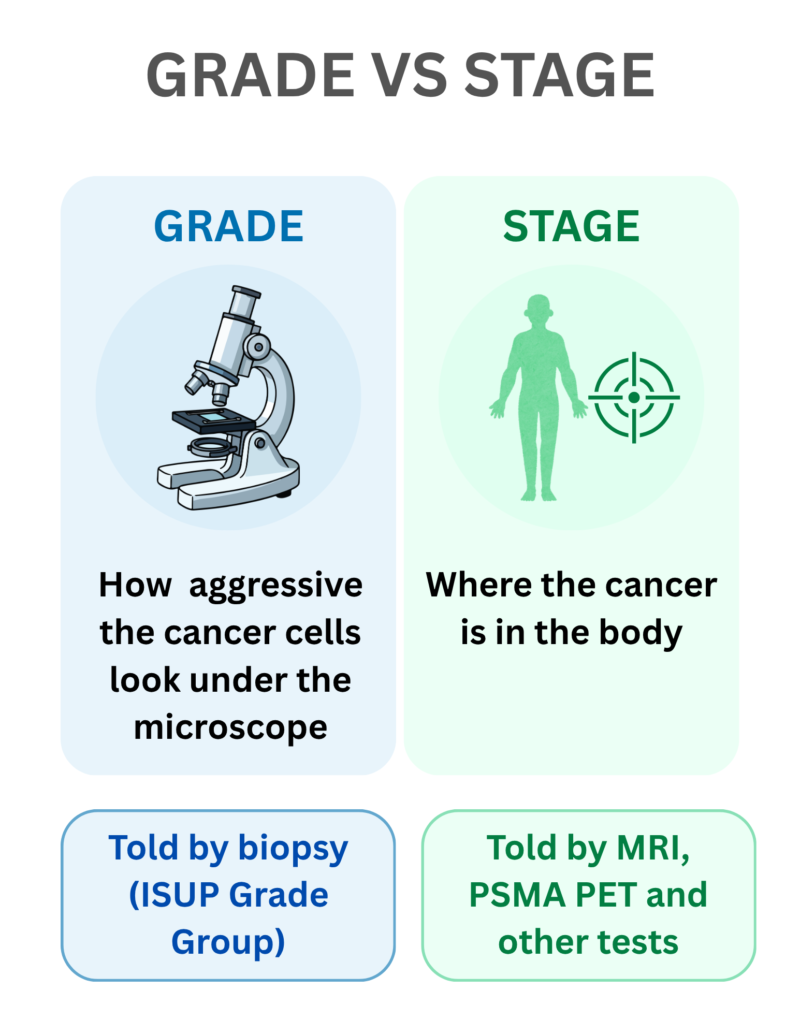
The Grade Group is not the same thing as the stage.
Grade tells us how aggressive the cancer looks.
Stage tells us where the cancer is.
Our patient’s biopsy showed ISUP Grade Group 4 prostate cancer.
This understandably surprised him.
His PSA was only 4.5.
Many patients assume:
“If my PSA isn’t very high, surely the cancer cannot be aggressive.”
Unfortunately, that is not always true.
A relatively modest PSA can occasionally be associated with high-grade prostate cancer.
That is why treatment decisions are never based on PSA alone.
Step 4: Has the cancer spread?
Once we know that prostate cancer is present, another question becomes important:
Where is it?
Patients often ask me:
“What PSA level means I need a PSMA PET scan?”
There is no single PSA number that answers that question.
We combine information from:
- the PSA;
- ISUP Grade Group;
- MRI;
- clinical stage;
- biopsy extent; and
- the overall risk category.
For men with unfavourable intermediate-risk or high-risk prostate cancer, PSMA PET/CT has become a particularly important staging tool where available and where the result would influence treatment planning.
Current European guidance recommends PSMA PET/CT for high-risk disease where available and supports it for unfavourable intermediate-risk disease to improve staging accuracy.
How much better is PSMA PET?
The Australian proPSMA trial compared PSMA PET/CT with conventional CT and bone scanning in men with high-risk prostate cancer.
Overall staging accuracy was approximately:
- 92% with PSMA PET/CT
- compared with 65% with conventional imaging.
In patient language, PSMA PET gave the correct staging information substantially more often.
Is PSMA PET Medicare-funded in Australia?
For eligible patients, yes.
MBS item 61563 currently provides Medicare funding for whole-body PSMA PET for initial staging when a patient:
- has confirmed intermediate- or high-risk prostate adenocarcinoma;
- has not previously been treated; and
- is considered suitable for locoregional treatment with curative intent.
The item can be claimed once in the patient’s lifetime.
Our patient had Grade Group 4 disease, so staging was particularly important despite his relatively modest PSA.
Fortunately, no distant metastatic disease was identified.
Step 5: Surgery or radiotherapy?
This is often the most difficult part of the discussion.
If prostate cancer remains potentially curable, patients commonly ask:
“Which is better—surgery or radiotherapy?”
For many men, there is no universally correct answer.
Both radical prostatectomy and modern radiotherapy are established treatments given with curative intent.
The right choice depends on:
- the stage and Grade Group;
- age and life expectancy;
- urinary function;
- sexual function;
- other medical conditions;
- anatomy;
- whether hormone therapy would accompany radiotherapy;
- likely side effects; and
- what matters most to the patient.
The 2026 EAU and ESMO guidelines both recognise surgery and radiotherapy as important treatment options for appropriately selected men with localised and locally advanced prostate cancer.
Option 1: Radical prostatectomy
A radical prostatectomy removes the prostate and seminal vesicles.
In Australia, this is commonly performed using robotic-assisted surgery, although the important treatment is the radical prostatectomy itself rather than the particular surgical platform.
For selected higher-risk patients, nearby pelvic lymph nodes may also be removed.
There is no single number of lymph nodes that every patient must have removed. The decision depends on the estimated likelihood of nodal disease and the surgical plan.
Is a TURP the same operation?
No.
This is an important misunderstanding.
A TURP, or transurethral resection of the prostate, removes prostate tissue from around the urinary channel to improve urinary obstruction.
A radical prostatectomy removes the entire prostate as cancer treatment.
They are completely different operations.
Option 2: Curative radiotherapy
Modern radiotherapy can also be used with curative intent for localised prostate cancer.
Depending on the risk group, it may involve external-beam radiotherapy, sometimes with a brachytherapy boost.
For higher-risk cancer, radiotherapy is frequently combined with hormone treatment.
For example, current European guidance recommends approximately:
- 4–6 months of ADT with radiotherapy for many men with unfavourable intermediate-risk disease; and
- 2–3 years of ADT with radiotherapy for high-risk localised disease.
The exact duration needs to be individualised according to the cancer, treatment strategy and patient’s health.
Our patient had Grade Group 4 disease.
Therefore, a radiotherapy discussion would not simply be:
“Radiotherapy instead of surgery.”
It would usually include discussion of:
radiotherapy + appropriate hormone therapy
versus a surgical pathway that might still require additional treatment later depending on the pathology and postoperative PSA.
Surgery versus radiotherapy at a glance
| Question | Radical prostatectomy | Radiotherapy |
| What is being done? | The prostate and seminal vesicles are surgically removed | Radiation is used to destroy prostate cancer cells |
| Hospital/procedure | Requires an operation and anaesthesia | Usually outpatient treatment |
| Hormone therapy | Not routinely required simply because surgery is performed | Often added for unfavourable intermediate- and high-risk disease |
| Urinary effects | Urinary leakage can occur, particularly after surgery | Irritative urinary symptoms may occur during or after treatment |
| Sexual effects | Erectile dysfunction can occur | Erectile function can also decline over time |
| Bowel effects | Usually less prominent | Bowel irritation can occur |
| If PSA rises later | Salvage radiotherapy may be possible | Salvage options depend on the pattern of recurrence |
| Best choice | Depends on the individual patient | Depends on the individual patient |
The important point is not to ask:
“Which treatment is better?”
It is:
“Which treatment gives this particular patient the best balance of cancer control, side effects and quality of life?”
Step 6: Do I need hormone injections?
Not every man with prostate cancer needs androgen-deprivation therapy, or ADT.
ADT lowers testosterone, one of the main growth signals used by prostate cancer cells.
After surgery
Men undergoing radical prostatectomy generally do not automatically receive immediate ADT.
Additional treatment depends on the final pathology, lymph-node findings and postoperative PSA.
With radiotherapy
ADT is much more commonly combined with radiotherapy for higher-risk disease because randomized evidence has shown better cancer-control outcomes in appropriate risk groups.
The duration depends on risk.
If cancer has already spread
If prostate cancer is metastatic, suppressing testosterone remains a foundation of treatment.
For many suitable men, however, ADT alone is no longer sufficient. It is commonly intensified with another systemic treatment, such as an androgen-receptor pathway inhibitor, with chemotherapy considered in selected situations.
That is a different treatment pathway from the localised cancer discussed in this patient’s case.
Step 7: What happens to PSA after surgery?
This is one of the most useful features of PSA.
Once the entire prostate has been removed, PSA is expected to fall to an undetectable or near-undetectable level after complete radical prostatectomy.
Current EAU guidance states that PSA is expected to be undetectable approximately two months after radical prostatectomy.
If PSA remains measurable, or becomes detectable again later, we investigate further.
That does not automatically mean visible metastatic cancer.
It means that prostate cells producing PSA may remain somewhere in the body and the situation needs to be assessed carefully.
Step 8: Will I still need radiotherapy after surgery?
Some men need surgery alone.
Others eventually benefit from radiotherapy.
Historically, men with adverse pathology were often offered radiotherapy routinely after prostatectomy.
That approach has changed.
Randomised trials and the ARTISTIC meta-analysis showed that for many men whose postoperative PSA becomes undetectable, careful PSA monitoring with early salvage radiotherapy if the PSA begins to rise can avoid unnecessary immediate radiotherapy without compromising short-term cancer-control outcomes.
This does not mean postoperative radiotherapy is never appropriate.
I would consider factors such as:
- whether PSA becomes undetectable;
- whether it subsequently rises;
- surgical margins;
- extension outside the prostate;
- seminal-vesicle involvement;
- lymph-node involvement;
- Grade Group; and
- other pathological risk features.
For selected very-high-risk situations, immediate postoperative treatment may still need discussion.
The principle is:
Do not give every patient extra treatment simply because we can. Give it when the expected benefit justifies it.
Step 9: Should I have genetic testing?
This is another area of rapidly changing practice.
Our patient was only 52 years old and had Grade Group 4 disease.
Even without a dramatic family history, I would review whether inherited genetic testing is appropriate and discuss the potential benefits of genetic assessment.
Inherited—or germline—testing can look for cancer-predisposition genes such as:
- BRCA1;
- BRCA2;
- ATM;
- PALB2; and
- genes involved in Lynch syndrome
depending on the clinical situation and the testing panel used.
Why might that matter?
A hereditary finding may:
- provide information about why the cancer developed;
- influence treatment options if the disease becomes advanced;
- affect future cancer-risk management; and
- be relevant to children, siblings and other close relatives.
However, I would not state that every man with localised prostate cancer automatically requires broad germline and tumour sequencing.
The role of tumour genomic testing becomes especially important in advanced disease and when a result could influence a targeted treatment.
What surprised me most about this patient
His PSA was only 4.5 ng/mL.
Yet his biopsy showed Grade Group 4 prostate cancer.
That is the teaching point I would want patients to remember.
PSA is enormously useful.
But PSA alone cannot tell us:
- whether cancer is present;
- how aggressive it is;
- whether it has spread; or
- which treatment is best.
We build the answer step by step.
PSA gives us the signal.
MRI shows us where to look.
Biopsy tells us what the cancer is.
PSMA PET helps tell us where it is.
Then the multidisciplinary team decides what to do about it.
What would I usually consider?
When a man comes to me with an elevated PSA, I would want to understand:
- Is the PSA genuinely and persistently elevated?
- Could infection or another temporary factor have affected it?
- What is his age and overall life expectancy?
- Does he have a significant family history?
- Is there a known BRCA2 or other inherited cancer-risk variant?
- What has happened to the PSA over time?
- What is his prostate volume and PSA density?
- What does the MRI show?
- Does he actually need a biopsy?
- If cancer is present, what is the ISUP Grade Group?
- Does he need PSMA PET staging?
- Is active surveillance appropriate, or is treatment required?
- If treatment is required, should we consider surgery, radiotherapy or a multimodality approach?
The aim is not simply to lower the PSA.
The aim is to understand what the PSA is trying to tell us.
What does this mean for patients in Australia?
There have been two particularly important changes for Australian patients.
First, the 2026 Australian early-detection guidelines now provide a modern risk-adapted pathway involving repeat PSA assessment and routine use of mpMRI before biopsy where further investigation is required.
Second, PSMA PET/CT is Medicare-funded under MBS item 61563 for eligible previously untreated men with intermediate- to high-risk prostate cancer who are being considered for curative locoregional treatment.
These changes mean that a man investigated today may follow a very different diagnostic pathway from someone investigated ten years ago.
The one message I want patients to remember
A high PSA is not a prostate cancer diagnosis.
It is a signal that needs to be interpreted properly.
For some men, a repeat blood test will be reassuring.
For others, MRI may show that biopsy is unnecessary.
For some, biopsy will identify a low-risk cancer that can simply be monitored.
And for a smaller group, like the gentleman I described, a relatively modest PSA can uncover a more aggressive cancer that needs treatment.
The important thing is to move through the pathway carefully:
High PSA → confirm the result → assess risk → MRI → biopsy if needed → stage the cancer if found → choose treatment according to the whole picture.
Key takeaways
- A high PSA does not automatically mean prostate cancer.
PSA is a starting point. The result needs to be interpreted alongside age, individual risk, previous PSA results and other clinical factors. - Modern prostate cancer diagnosis is a step-by-step process.
When further investigation is needed, prostate MRI usually comes before biopsy. The biopsy confirms whether cancer is present and tells us how aggressive it appears, while PSMA PET may help stage selected higher-risk cancers. - Treatment depends on the whole picture, not one test result.
Surgery and radiotherapy are both potentially curative options for appropriately selected men, and hormone therapy may form part of treatment for higher-risk disease. - The most important change in prostate cancer care is personalisation.
PSA, MRI, pathology, PSMA PET, genetics, overall health and patient preferences are increasingly considered together to choose the most appropriate treatment and follow-up strategy.
Key evidence
- Prostate Cancer Foundation of Australia. New guidelines for the early detection of prostate cancer. Accessed August 28, 2026. https://www.prostate.org.au/resources/clinical-guidelines-for-the-early-detection-of-prostate-cancer/
- Cornford P, van den Bergh RCN, Briers E, et al. EAU-EANM-ESTRO-ESUR-ISUP-SIOG Guidelines on Prostate Cancer—2026 update. Part I: screening, diagnosis, and local treatment with curative intent. Eur Urol. Published online July 2026. doi:10.1016/j.eururo.2026.04.013
- Walz J, Attard G, Bjartell A, et al. Local and locoregional prostate cancer: ESMO Clinical Practice Guideline for diagnosis, treatment and follow-up. Ann Oncol. 2026;37(4):453-469. doi:10.1016/j.annonc.2025.12.009
- Kasivisvanathan V, Rannikko AS, Borghi M, et al. MRI-targeted or standard biopsy for prostate-cancer diagnosis. N Engl J Med. 2018;378(19):1767-1777. doi:10.1056/NEJMoa1801993
- Hofman MS, Lawrentschuk N, Francis RJ, et al. Prostate-specific membrane antigen PET-CT in patients with high-risk prostate cancer before curative-intent surgery or radiotherapy (proPSMA): a prospective, randomised, multicentre study. Lancet. 2020;395(10231):1208-1216. doi:10.1016/S0140-6736(20)30314-7
- Vale CL, Fisher D, Kneebone A, et al. Adjuvant or early salvage radiotherapy for the treatment of localised and locally advanced prostate cancer: a prospectively planned systematic review and meta-analysis of aggregate data. Lancet. 2020;396(10260):1422-1431. doi:10.1016/S0140-6736(20)31952-8
- Australian Government Department of Health, Disability and Ageing. Medicare Benefits Schedule item 61563. Accessed August 28, 2026. https://www9.health.gov.au/mbs/fullDisplay.cfm?q=61563&qt=item&type=item
Frequently asked questions (FAQs)
- Does a PSA of 4.5 mean I have prostate cancer?
No.
A PSA of 4.5 may require further investigation depending on your age and individual risk, but PSA alone cannot diagnose prostate cancer.
- Should an elevated PSA be repeated?
Often, yes.
Current Australian guidance recommends repeating PSA when it reaches the relevant age- and risk-based action level before proceeding further, provided there is no reason for more urgent assessment.
- What PSA is considered high in Australia?
There is no single threshold for everyone.
For average-risk men aged 50–69, the current Australian action level is 3.0 ng/mL. Lower thresholds are used for some higher-risk men, while recommendations differ for older age groups.
- Does a high PSA mean I need a biopsy?
Not automatically.
If further assessment is indicated, prostate MRI is generally performed first. The MRI result, PSA density and other risk factors then help determine whether biopsy is necessary.
- Can an MRI rule out prostate cancer?
No.
A reassuring MRI can substantially reduce the likelihood of clinically significant cancer, but MRI does not detect every prostate cancer.
- What does PI-RADS 5 mean?
PI-RADS 5 means the MRI appearance is highly suspicious for clinically significant prostate cancer.
A biopsy is usually required to confirm the diagnosis.
- Is a transperineal biopsy better than a transrectal biopsy?
The transperineal approach is now preferred in Australian guidance because it reduces the risk of infectious complications and allows effective targeting of the prostate.
- What PSA means I need a PSMA PET scan?
There is no single PSA threshold.
PSMA PET staging is determined by the overall prostate cancer risk, including Grade Group, PSA, stage and other findings.
- Is PSMA PET covered by Medicare?
For eligible men, yes.
MBS item 61563 covers initial PSMA PET staging for previously untreated intermediate- to high-risk prostate cancer when curative locoregional therapy is being considered.
- Is surgery better than radiotherapy?
Not for every patient.
Both are established potentially curative treatments. The decision depends on the cancer’s risk, age and health, urinary and sexual function, expected side effects and personal preferences.
- Will I need hormone injections if I choose radiotherapy?
Possibly.
Hormone therapy is commonly added to radiotherapy for unfavourable intermediate-risk and high-risk prostate cancer. The duration depends on the risk group and treatment strategy.
- What should my PSA be after prostate surgery?
After complete radical prostatectomy, PSA is expected to become undetectable, generally by around two months.
About Dr Dilanka De Silva
Dr Dilanka De Silva is a Melbourne-based Medical Oncologist and Cancer Genetics Physician with experience in precision oncology, cancer genetics and complex second opinions.
He completed fellowship training at Memorial Sloan Kettering Cancer Center in New York and reviews Australian and international patients with prostate cancer, including patients seeking second opinions from Sri Lanka, the Maldives, Indonesia and the Philippines.
For complex prostate cancer, treatment planning may involve collaboration with urologists, radiation oncologists, nuclear-medicine specialists, radiologists, pathologists and genetics specialists.
Dr Dilanka De Silva
MBBS, MRCP(UK), MRCP(UK SCE Oncology), FRACP, PhD
Medical Oncologist & Cancer Genetics Physician
Memorial Sloan Kettering Cancer Center Fellow (New York, USA)