
High-risk prostate cancer care is changing. Treatment decisions increasingly consider not only where the cancer is located, but also how it may behave, whether microscopic disease may be present and which specialists should contribute before treatment begins.
Who this is for
This article is for anyone recently diagnosed with prostate cancer, particularly men with high-risk disease who are deciding between surgery, radiotherapy and other treatment options.
It may also help patients and families understand why treatment decisions are no longer based only on what can be seen on a scan.
Not every man with prostate cancer needs to see a medical oncologist. Many men with lower-risk disease can be managed successfully with active surveillance, surgery or radiotherapy alone.
However, when the cancer has high-risk or aggressive features, discussing the complete treatment strategy before starting treatment may be valuable.
Clinical observation
A 57-year-old gentleman came to see me after recently being diagnosed with prostate cancer.
His PSA was 9.6 ng/mL.
His biopsy showed ISUP Grade Group 5 prostate cancer, also described as a Gleason score of 4 + 5 = 9. In patient terms, this meant that the cancer cells looked highly abnormal under the microscope and had a greater risk of growing or spreading.
His MRI suggested that the cancer had extended just beyond the outer edge of the prostate. Fortunately, his staging investigations did not show evidence of distant metastases.
He was otherwise fit and healthy, with no significant family history of prostate cancer.
After meeting his urologist, he underwent radical prostatectomy to remove the prostate.
Medical Oncology became involved only afterwards.
As I reflected on his case, I found myself asking a question that would have been discussed much less often several years ago:
Would his treatment planning have been different if medical oncology and the broader multidisciplinary team had been involved before surgery?
We cannot know whether his individual outcome would have changed.
However, the question is becoming increasingly relevant as systemic treatments move into earlier stages of prostate cancer care.
The key question in high-risk prostate cancer care
For a man with high-risk prostate cancer, should treatment planning begin with the question:
“Can the prostate be removed?”
Or should it begin with a broader question:
“Which treatment, or combination and sequence of treatments, may offer this patient the best balance of long-term cancer control, side effects and quality of life?”
Modern prostate cancer care increasingly benefits from considering the second approach.
What surprised me
For many years, treatment decisions were largely driven by what they could see on a CT scan, MRI or bone scan.
If the cancer appeared confined to the prostate, doctors ususally recommended surgery or radiotherapy.
If the PSA later rose or the cancer spread, Medical Oncology became more involved.
That approach is changing.
Imaging remains essential, but even modern scans cannot identify every microscopic cancer cell.
Doctors now consider not only where the cancer appears to be located, but also how it may behave.
This may include:
- the PSA level and pattern;
- the Grade Group and other biopsy findings;
- whether the cancer has extended beyond the prostate;
- lymph-node involvement;
- genetic and molecular findings;
- the estimated risk of microscopic disease;
- the patient’s age, health, priorities and preferences.
The scan remains extremely important.
However, it no longer tells the whole story.
From anatomy-driven to biology-informed cancer care
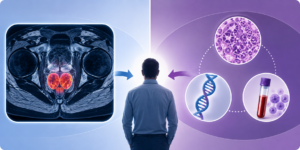
Traditionally, cancer treatment was often anatomy-driven.
Doctors asked:
“Where is the cancer?”
Today, treatment is becoming increasingly biology-informed.
Doctors also ask:
“How is this cancer likely to behave?”
This does not mean that tumour biology has replaced imaging.
Both are needed.
Imaging shows doctors where they can see the cancer. Biopsy results, PSA tests and genetic information help them estimate how quickly it may grow and how likely it is to return.
For some patients, this broader understanding may affect whether treatment involves:
- surgery;
- radiotherapy;
- hormone therapy;
- androgen-receptor medicines;
- chemotherapy;
- genetic testing;
- molecular testing;
- a clinical trial;
- or a carefully planned combination of these treatments.
Why recent prostate cancer research matters
The PROTEUS study provides one recent example of how prostate cancer treatment is changing.
It involved 2,109 men with high-risk localised or locally advanced prostate cancer who were planning surgery.
The study investigated whether adding apalutamide to hormone therapy before and after surgery could improve cancer-control outcomes.
At five years, approximately:
- 78 in every 100 men who received apalutamide plus hormone therapy were alive without distant metastases;
- 74 in every 100 men who received hormone therapy plus placebo were alive without distant metastases.
This was an absolute difference of approximately five additional men in every 100 remaining free from distant spread at five years.
Apalutamide was also associated with more medically important side effects.
Australian PBS information: Apalutamide is available through the Pharmaceutical Benefits Scheme for certain eligible patients with non-metastatic castration-resistant prostate cancer and metastatic hormone-sensitive prostate cancer. However, its use with hormone therapy before and after surgery for high-risk localised prostate cancer, as studied in PROTEUS, is not currently an established PBS-funded indication. Eligibility and access should therefore be confirmed with the treating oncologist and checked against the current PBS restrictions.
The detailed PROTEUS findings are discussed separately in our article, “Can treatment around prostate cancer surgery reduce the risk of recurrence?”
For this article, the broader lesson is more important:
Doctors may no longer reserve systemic treatment only for cancer that has already returned or spread.
In carefully selected patients, it may become part of treatment planning around curative local treatment.
However, PROTEUS did not prove that every man should receive apalutamide, nor did it establish that every patient must see a medical oncologist before surgery. It also did not directly compare the study approach with surgery alone or with modern radiotherapy combined with hormone therapy.
The treatment team at a glance
| Specialist | Main contribution |
| Urologist | Assesses and performs prostate surgery and supports recovery |
| Radiation oncologist | Assesses and delivers curative or postoperative radiotherapy |
| Medical oncologist | Advises on treatments that work throughout the body, including hormone therapy, chemotherapy, targeted treatments and clinical trials |
| Radiologist and nuclear-medicine specialist | Interprets MRI, CT, bone scans and PSMA PET |
| Pathologist | Examines biopsy or surgical tissue and determines the Grade Group and other risk features |
| Genetics team | Assesses inherited and tumour-related genetic changes that may affect the patient or family |
| Multidisciplinary team | Brings the different specialist opinions together to develop a coordinated plan |
Medical oncology: The conductor of modern cancer care
Every member of the cancer team has an essential role.
The urologist may remove the prostate.
The radiation oncologist may deliver curative radiotherapy.
The radiologist interprets increasingly sophisticated imaging.
The pathologist explains how aggressive the tumour appears under the microscope.
The genetics team assesses whether inherited or tumour-related changes may influence treatment or family counselling.
Medical Oncology contributes an understanding of treatments that act throughout the body and how these treatments may fit before, during or after local treatment.
This is where the orchestra comparison can be helpful.
Every musician is important.
The music works only when each instrument enters at the right time and in the right sequence.
However, modern cancer care does not always have one permanent conductor.
Depending on the patient, the urologist, radiation oncologist, medical oncologist or multidisciplinary team may initially coordinate care.
The important point is not which specialist is “in charge.”
The important point is that the complete treatment pathway is considered before major decisions are made.
What a medical oncologist may add
For a man with high-risk prostate cancer, a medical oncologist may help answer questions such as:
- Is treatment that acts throughout the body relevant at this stage?
- Could hormone therapy or another medicine be useful before or after local treatment?
- What benefits and side effects might be expected?
- Is genetic or molecular testing relevant?
- Is there a suitable clinical trial?
- How could the first treatment affect future options?
- What treatment might be needed if the PSA later rises?
Medical Oncology does not replace surgery or radiotherapy.
Its role is to help ensure that systemic treatment is considered as part of the overall strategy when appropriate.
This transformation began before prostate cancer
Breast cancer
Doctors may give chemotherapy, targeted therapy or immunotherapy before surgery to selected patients with HER2-positive or triple-negative breast cancer.
This can treat both the visible tumour and possible microscopic disease. It may also provide information that helps guide treatment after surgery.
This approach is not required for every breast cancer patient, but it has become an important strategy for particular higher-risk subtypes.
Lung cancer
Doctors may use chemotherapy, immunotherapy or targeted therapy before or after surgery for selected patients with operable lung cancer.
Treatment selection may depend on the cancer’s stage, pathology and molecular features.
Bladder cancer
For selected patients with muscle-invasive bladder cancer, chemotherapy before surgery has an established role.
Immunotherapy, targeted treatments and antibody–drug conjugates have also expanded options for more advanced disease.
Prostate cancer
Prostate cancer may now be moving further in the same direction.
Local treatment remains central, but doctors are increasingly investigating whether systemic therapy should be introduced earlier for carefully selected patients.
The biggest change
The discussion is no longer simply:
“Can this cancer be removed?”
It is increasingly:
“Which treatments should be used, and in what order, to provide the best balance of long-term cancer control, side effects and quality of life?”
That may require consideration of:
- surgery;
- radiotherapy;
- hormone therapy;
- androgen-receptor inhibitors;
- chemotherapy;
- targeted treatments;
- genetic testing;
- clinical trials;
- surveillance;
- long-term follow-up and survivorship.
Not every patient needs all these treatments.
The value of multidisciplinary assessment is deciding which treatments are relevant and which can safely be avoided.
What this means for patients
For patients outside Australia, including those in Sri Lanka, the Maldives, Indonesia and the Philippines, access to imaging, medicines and multidisciplinary care may differ. Treatment recommendations should be adapted to the services, approvals and funding available in the patient’s country.
A diagnosis of high-risk prostate cancer does not automatically mean that one treatment is best for everyone.
Before starting treatment, patients may wish to ask:
- Have both surgery and radiotherapy been considered?
- Has my case been reviewed by a multidisciplinary team?
- Could treatment that works throughout the body be relevant?
- Should I consider genetic testing?
- Is a clinical trial available?
- Might I need additional treatment after surgery or radiotherapy?
- How could each option affect urinary, sexual and general health?
- What is the aim of treatment: cure, reducing recurrence risk or long-term control?
An early multidisciplinary discussion may help patients understand the complete pathway before making an irreversible treatment decision.
However, current evidence does not prove that every patient with high-risk prostate cancer must see a medical oncologist before local treatment.
Doctors should decide this individually, based on the patient’s risk, available treatments and local healthcare system.
My clinical perspective
For decades, visible anatomy was one of the main drivers of prostate cancer treatment.
It remains fundamental.
However, pathology, PSA, tumour biology, genetics and the estimated risk of microscopic disease now contribute increasingly to treatment planning.
The goal is no longer simply to remove or irradiate the cancer that can be seen.
It is to design the entire journey—from diagnosis and initial treatment to follow-up and long-term survivorship.
For selected patients with high-risk prostate cancer, that conversation may be most valuable before the first major treatment decision is made.
I believe Medical Oncology will play an increasingly important part in these discussions.
However, the best outcomes are unlikely to come from one specialty acting alone.
They will come from urologists, radiation oncologists, medical oncologists, radiologists, pathologists, genetics specialists and patients working together to choose the right treatment, in the right sequence, for the right person.
Key takeaways
- High-risk prostate cancer treatment is increasingly guided by both imaging and the biological features of the cancer.
- Recent research suggests that systemic treatment may have a role earlier in the care of carefully selected patients.
- Medical Oncology can help integrate hormone therapy, other medicines, genetics and clinical trials with surgery or radiotherapy.
- This does not mean that Medical Oncology replaces the urologist or radiation oncologist.
- Early multidisciplinary planning may help patients understand the full treatment pathway before making a major or irreversible decision.
References
- Taplin ME, Gleave M, Shore ND, et al. Perioperative apalutamide in high-risk localized prostate cancer. N Engl J Med. Published online May 31, 2026. doi:10.1056/NEJMoa2603878
- Antonarakis ES. A watershed moment in the perioperative treatment of prostate cancer. N Engl J Med. Published online May 31, 2026. doi:10.1056/NEJMe2606250
- European Association of Urology. EAU Guidelines on Prostate Cancer. 2026 edition. Accessed June 26, 2026. https://uroweb.org/guidelines/prostate-cancer
- American Society of Clinical Oncology. Potential new targeted treatment option for people with localized high-risk prostate cancer. Published May 31, 2026. Accessed August 1, 2026. https://www.asco.org/about-asco/press-center/potential-new-targeted-treatment-localized-high-risk-prostate
Frequently asked questions (FAQs)
Should every patient with prostate cancer see a medical oncologist?
No.
Many men with low-risk prostate cancer can be managed successfully with active surveillance, surgery or radiotherapy without systemic treatment.
A medical oncologist may be particularly helpful when the cancer has high-risk features, has spread or returned, may need treatment that works throughout the body, or may qualify for a clinical trial.
Should every man with high-risk prostate cancer see a medical oncologist before surgery?
Not necessarily.
Current evidence does not establish this as a requirement for every patient.
However, early multidisciplinary assessment may be valuable when hormone therapy, another systemic treatment, radiotherapy, genetic testing or a clinical trial could influence the treatment plan.
Does Medical Oncology replace the surgeon?
No.
Surgery remains an important curative treatment for appropriately selected patients.
The aim is not to replace surgery. It is to ensure that surgery is considered as part of the complete treatment strategy.
Does tumour biology matter more than imaging?
Both matter.
Imaging helps show where visible cancer is located.
Pathology, PSA and genetic or molecular features help doctors estimate how the cancer may behave.
Treatment decisions should not be based on imaging or tumour biology alone.
Why is prostate cancer treatment changing now?
New hormone treatments, advanced imaging, genetic testing, molecular testing and clinical trials are providing doctors with more information and more treatment options.
Research such as PROTEUS is also examining whether systemic treatment can improve outcomes when used around surgery rather than being reserved until after recurrence.
Should I seek a second opinion?
A second opinion may be helpful when:
- the cancer is high-risk or locally advanced;
- both surgery and radiotherapy are reasonable options;
- systemic treatment is being considered;
- specialists have provided different recommendations;
- genetic testing or a clinical trial may be relevant;
- you want to understand the entire treatment pathway before proceeding.
Dr Dilanka De Silva
MBBS, MRCP(UK), MRCP(UK SCE Oncology), FRACP, PhD
Medical Oncologist & Cancer Genetics Physician
Memorial Sloan Kettering Cancer Center Fellow (New York, USA)