
Who this is for
This article is for you if:
- You have recently been told you have triple-positive breast cancer.
- Your pathology report says ER-positive, PR-positive and HER2-positive.
- You are trying to understand whether surgery or treatment should come first.
- You want to understand what happens if cancer remains after treatment before surgery.
- You are seeking a second opinion about HER2-positive breast cancer treatment.
Being told that a breast cancer is “triple positive” can sound frightening and confusing.
You may suddenly be hearing terms such as ER, PR, HER2, trastuzumab, pertuzumab and hormone therapy for the first time.
The important thing I explain to my patients is this:
Triple-positive breast cancer has more than one treatment target. That gives us several effective ways to treat it.
The patient question
One of the most common questions I hear is:
“I have triple-positive breast cancer. What happens next — surgery or treatment first?”
The answer depends mainly on the size of the cancer, whether lymph nodes are involved, the overall stage and the individual patient.
For some small, node-negative cancers, surgery first may be entirely appropriate.
For larger HER2-positive cancers or cancers involving lymph nodes, treatment before surgery is often preferred because it does something surgery alone cannot do:
It allows us to see how sensitive the cancer is to treatment.
What does triple positive-breast cancer mean?
Breast cancer cells are routinely tested for three important markers:
- ER — oestrogen receptor
- PR — progesterone receptor
- HER2 — a growth-promoting protein on the cancer cell
When all three are positive, the cancer is commonly described as triple positive.
In simple terms, the cancer may be receiving growth signals through:
- Hormones, particularly oestrogen.
- HER2 signalling.
The advantage is that we can target both pathways.
Treatment may therefore include:
- chemotherapy
- HER2-targeted treatment such as trastuzumab
- sometimes a second HER2-targeted treatment such as pertuzumab
- hormone-blocking treatment
This is why triple-positive breast cancer can seem complicated at first, but it also means that we have several effective treatment options.
What surprised me
One of the most important changes in HER2-positive breast cancer treatment is that the order of treatment can sometimes be just as important as the treatment itself.
Years ago, the instinct with an operable breast cancer was often:
Remove it first. Treat afterwards.
Today, for many patients with larger or lymph-node-positive HER2-positive breast cancer, we deliberately treat the cancer before surgery.
Why?
Because the cancer becomes its own test of treatment sensitivity.
If the tumour disappears completely, that is reassuring.
If cancer remains, we can use that information to change what we give afterwards.
This ability to adapt treatment according to response is one of the major advances in modern HER2-positive breast cancer care.
The first important decision: surgery first or treatment first?
If the cancer is small and the lymph nodes appear clear
For many patients with a small, node-negative HER2-positive cancer, surgery first may be reasonable.
A commonly used approach for appropriately selected patients is:
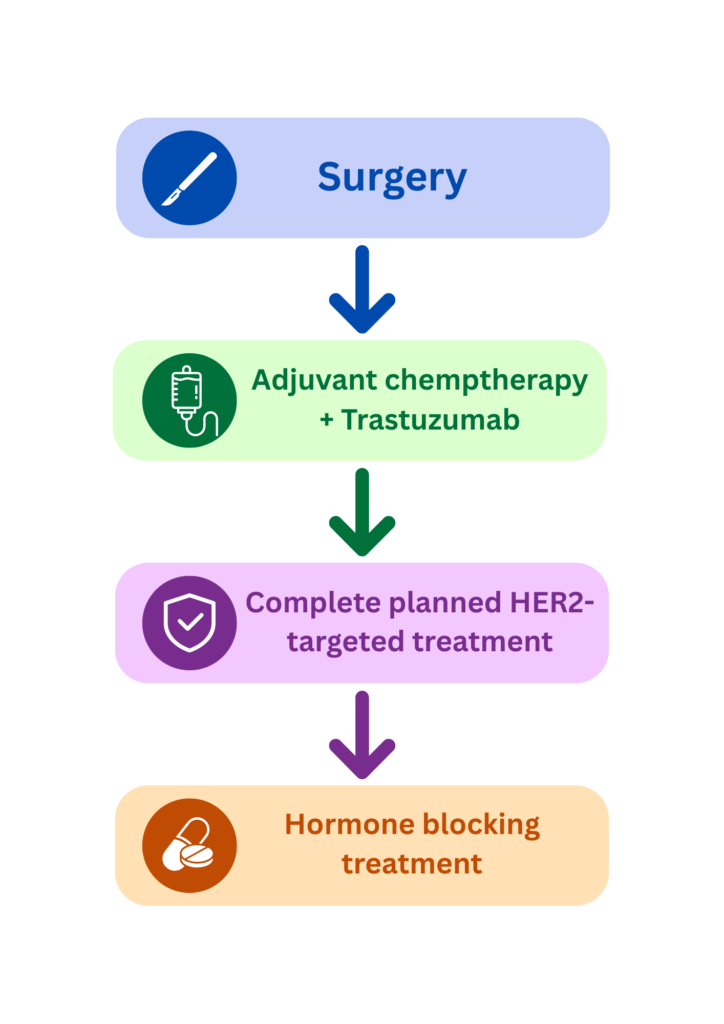
The APT trial studied 406 patients with HER2-positive, node-negative cancers measuring up to 3 cm who received paclitaxel and trastuzumab.
After approximately 10 years:
- about 91 in every 100 patients were alive without an invasive breast cancer event
- about 96 in every 100 had not experienced recurrence of the original breast cancer
- about 99 in every 100 had not died from breast cancer
These are excellent long-term results.
However, this does not mean that every HER2-positive cancer up to 3 cm should automatically receive this regimen.
Tumour size, grade, lymphovascular invasion, hormone receptor status, patient age, heart health and other clinical factors still matter.
If the cancer is larger or lymph nodes are involved
For many patients with a HER2-positive cancer larger than approximately 2 cm, or where lymph nodes are involved, I generally favour discussing systemic treatment before surgery.
This may include:
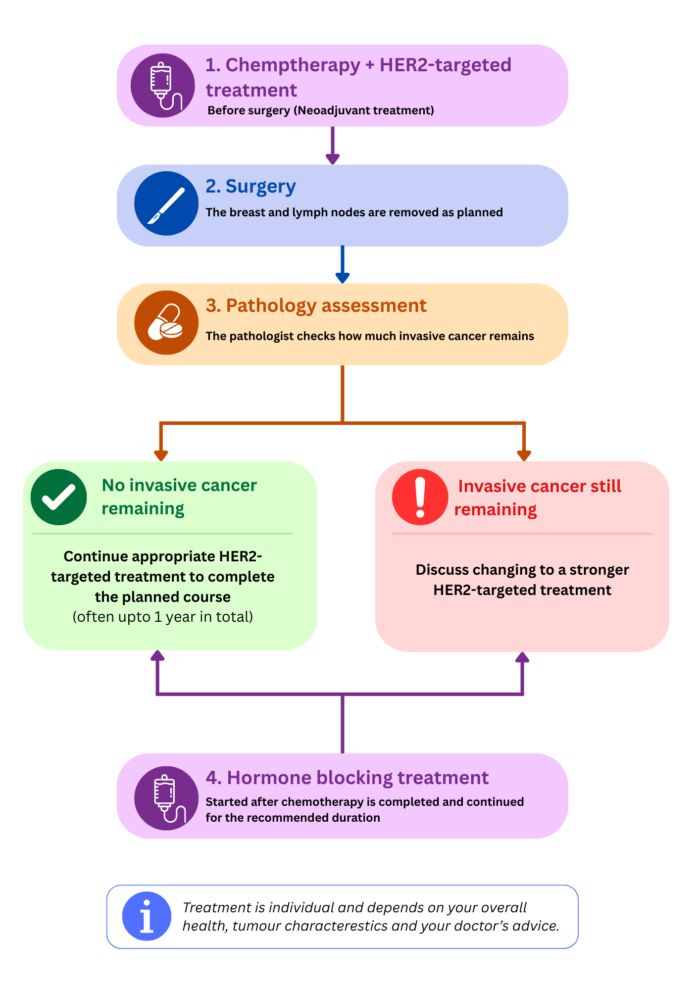
This is called neoadjuvant treatment, which simply means treatment given before surgery.
For patients at higher risk, dual HER2 blockade with trastuzumab and pertuzumab may be appropriate depending on stage, treatment setting, comorbidities and access.
Why give treatment before surgery?
There are two major reasons.
We can see whether the treatment has worked
The ideal result is that no invasive cancer remains in the breast or lymph nodes at surgery.
This is called a pathological complete response, or pCR.
In simple terms:
No invasive cancer is found when the surgical tissue is examined under the microscope.
For many patients with HER2-positive breast cancer, achieving a pCR is associated with a more favourable outlook.
If cancer remains, we can change the treatment
This is one of the strongest reasons to treat higher-risk HER2-positive cancers before surgery.
The KATHERINE trial studied patients who still had invasive HER2-positive breast cancer remaining after preoperative chemotherapy and HER2-targeted treatment.
Instead of simply continuing trastuzumab, patients were randomly assigned to receive either trastuzumab or T-DM1, also called trastuzumab emtansine or Kadcyla.
The long-term results are clinically important.
At seven years:
- about 81 in every 100 patients receiving T-DM1 remained free of invasive disease
- compared with about 67 in every 100 receiving trastuzumab
Overall survival at seven years was:
- about 89% with T-DM1
- compared with about 84% with trastuzumab
T-DM1 therefore not only reduced recurrence risk but also improved overall survival.
A patient I recently reviewed
I recently reviewed a woman from Canada in her mid-40s.
Her breast cancer measured approximately 27 mm, or 2.7 cm. It was triple positive, and she proceeded directly to surgery.
Surgery first was not necessarily wrong.
However, for a HER2-positive cancer of this size, I would usually have preferred a discussion about treatment before surgery.
The reason is simple.
Once the tumour has been removed, we lose the opportunity to see whether it would have completely disappeared with systemic treatment.
We also lose the opportunity to use that response to guide what treatment should come next.
That does not mean the patient cannot still receive effective treatment.
It means we have lost one piece of clinically useful information that can help personalise postoperative treatment.
What imaging is usually needed?
Before treatment, assessment often includes:
- mammography
- breast and lymph-node ultrasound
- breast MRI when appropriate
These investigations help define the true extent of the cancer and assess the lymph nodes.
Whole-body staging scans are not required for every patient with a small, early breast cancer.
For patients with larger tumours, lymph-node involvement, locally advanced disease or concerning symptoms, additional staging may include CT, bone imaging or PET/CT depending on the clinical situation.
A PET scan can show both where an abnormality is located and whether it is metabolically active.
What happens after surgery?
If no invasive cancer remains
If a pathological complete response has been achieved, HER2-targeted treatment is generally continued to complete the planned course, often approximately one year in total.
For triple-positive disease, hormone-blocking treatment is also introduced.
The exact HER2-targeted regimen after surgery depends on the treatment already received, the original stage and the individual patient.
If invasive cancer remains
For patients with residual invasive HER2-positive disease after neoadjuvant treatment, T-DM1 has been an established post-neoadjuvant treatment based on KATHERINE.
More recently, the DESTINY-Breast05 trial showed that trastuzumab deruxtecan, or T-DXd, provided better invasive disease-free survival than T-DM1 in patients with high-risk residual HER2-positive early breast cancer. However, T-DXd has a different side-effect profile, including an important risk of interstitial lung disease. How these results are incorporated into routine treatment will depend on regulatory approval, PBS access, individual risk and multidisciplinary discussion.
When do we start hormone treatment?
Hormone-blocking treatment is an important part of treatment for triple-positive breast cancer because the cancer is also driven by oestrogen and/or progesterone signalling.
It usually begins after chemotherapy has finished and can generally be given at the same time as ongoing HER2-targeted treatment.
Depending on age and menopausal status, options may include:
- tamoxifen
- an aromatase inhibitor
- ovarian suppression together with endocrine treatment
The exact choice should be individualised according to menopausal status, recurrence risk, bone health, side effects and patient preference.
What about pertuzumab?
Pertuzumab is another HER2-targeted treatment.
For appropriately selected patients with larger, locally advanced or lymph-node-positive HER2-positive breast cancer, it may be combined with trastuzumab and chemotherapy before surgery.
The APHINITY trial also demonstrated a long-term invasive disease-free survival benefit from adding pertuzumab to trastuzumab and chemotherapy, with the clearest absolute benefit seen in patients with node-positive disease.
At eight years, among node-positive patients:
- approximately 86.1% receiving pertuzumab remained free of invasive disease
- compared with 81.2% without pertuzumab
The overall survival difference for the whole trial population had not reached statistical significance at that analysis.
What about neratinib?
The ExteNET trial studied neratinib after completion of trastuzumab-based treatment.
The clearest benefit was seen in hormone receptor-positive, HER2-positive disease, particularly when neratinib was started within one year of completing trastuzumab.
In that subgroup, the absolute improvement in invasive disease-free survival at five years was approximately 5 percentage points.
Australian PBS point
As of the latest PBS Medicine Status information I found, neratinib is not PBS listed for early breast cancer following a previous PBAC decision not to recommend listing.
What about CDK4/6 inhibitors?
CDK4/6 inhibitors include:
- palbociclib
- ribociclib
- abemaciclib
These drugs are very important in hormone receptor-positive breast cancer.
However, the established adjuvant early-breast-cancer indications are primarily in HER2-negative disease.
Therefore, CDK4/6 inhibitors are not currently routine standard therapy for early, curable triple-positive breast cancer.
At present, we do not have sufficient evidence to routinely add a CDK4/6 inhibitor to curative treatment for early triple-positive breast cancer.
The PATINA trial
PATINA studied patients with hormone receptor-positive, HER2-positive advanced or metastatic breast cancer.
Patients receiving maintenance HER2-targeted therapy and endocrine therapy were assigned to receive palbociclib or no palbociclib.
Median progression-free survival was:
- 44.3 months with palbociclib
- 29.1 months without palbociclib
So, in simple terms, adding palbociclib delayed progression by about 15 months on average in this trial.
However, this distinction is essential:
PATINA was a metastatic breast cancer trial.
It was not a trial of early, curable triple-positive breast cancer.
Therefore, we cannot automatically take the PATINA result and add palbociclib after curative treatment for early disease.
Australian PBS point
Current PBS palbociclib listing information relates to HR-positive, HER2-negative advanced or metastatic breast cancer, not HER2-positive disease.
What does this mean in Australia?
Australia has good access to several important HER2-targeted treatments through the PBS, although eligibility depends on the specific clinical setting and PBS criteria.
Trastuzumab is PBS listed for eligible HER2-positive early breast cancer and can be used in both early and advanced HER2-positive disease.
T-DM1 (trastuzumab emtansine) has been PBS listed for eligible patients with early HER2-positive breast cancer since 2020.
The position for pertuzumab in early-stage disease is more complicated. PBAC recommended a change to the early-stage listing in 2025, but as of the latest Medicine Status update, that expanded listing had not yet proceeded to PBS listing. Availability and funding should therefore be checked at the time treatment is being planned.
Newer treatments such as T-DXd are evolving rapidly. PBS listings may differ according to the exact breast cancer setting, so current eligibility should always be checked rather than assumed.
What I would usually discuss with my patient
This is the new Diamond section I would add.
Every patient is different, but when I review someone with newly diagnosed triple-positive breast cancer, I usually focus on five questions:
- How large is the cancer?
- Are any lymph nodes involved?
- Would treatment before surgery give us useful information about how the cancer responds?
- If residual cancer remains, what additional HER2-targeted treatment may reduce the risk of recurrence?
- What endocrine treatment is appropriate once chemotherapy is complete?
The aim is not simply to give the strongest possible treatment.
The aim is to give the right treatment in the right sequence, using the cancer’s response to guide what happens next whenever possible.
The most important message
Triple-positive breast cancer may sound complicated because three receptors are involved.
But it also means that we have several effective treatment targets.
For many small, node-negative cancers, surgery first may be entirely appropriate.
For larger cancers or cancers involving lymph nodes, treatment before surgery is often particularly valuable because it tells us how sensitive the cancer is and allows us to adapt treatment afterwards.
Modern HER2-positive breast cancer care is therefore not simply about choosing chemotherapy, surgery or targeted therapy.
It is about choosing the right sequence — and using the response to one treatment to guide the next.
Key takeaways
- Triple-positive breast cancer has more than one treatment target.
Both the hormone pathway and HER2 pathway can be treated. - Surgery is not always the first step.
For many larger or lymph-node-positive HER2-positive cancers, treatment before surgery provides important information. - Response to treatment can change what happens next.
If invasive cancer remains after preoperative treatment, additional HER2-targeted treatment can reduce recurrence risk. - T-DM1 has strong long-term evidence after residual disease.
KATHERINE demonstrated both improved invasive disease-free survival and overall survival. - New treatments are continuing to change the field.
DESTINY-Breast05 has now shown improved invasive disease-free survival with T-DXd compared with T-DM1 in selected high-risk residual disease, but treatment decisions must consider toxicity, approval and access.
Key evidence
- Tolaney SM, Tarantino P, Graham N, et al. Adjuvant paclitaxel and trastuzumab for node-negative, HER2-positive breast cancer: final 10-year analysis of the open-label, single-arm, phase 2 APT trial. Lancet Oncol. 2023;24(3):273-285. doi:10.1016/S1470-2045(23)00051-7.
- Geyer CE Jr, Untch M, Huang CS, et al. Survival with trastuzumab emtansine in residual HER2-positive breast cancer. N Engl J Med. 2025;392(3):249-257. doi:10.1056/NEJMoa2406070.
- Piccart M, Procter M, Fumagalli D, et al. Adjuvant pertuzumab and trastuzumab in early HER2-positive breast cancer in the APHINITY trial: third interim overall survival analysis with efficacy update. J Clin Oncol.
- Chan A, Moy B, Mansi J, et al. Final efficacy results of neratinib in HER2-positive hormone receptor-positive early-stage breast cancer from the phase III ExteNET trial. Clin Breast Cancer. 2021;21(1):80-91.e7.
- Loibl S, Park YH, Shao Z, et al. Trastuzumab deruxtecan in residual HER2-positive early breast cancer. N Engl J Med. 2026;394(9):845-857. doi:10.1056/NEJMoa2514661.
- Metzger O, Mandrekar S, Goel S, et al. Palbociclib for hormone receptor–positive, HER2-positive advanced breast cancer. N Engl J Med. 2026;394(5):451-462. doi:10.1056/NEJMoa2511218
Frequently asked questions (FAQs)
- Does triple-positive breast cancer mean the cancer is more aggressive?
HER2-positive cancers have historically been considered biologically aggressive, but modern HER2-targeted treatment has transformed outcomes. Prognosis depends on stage, lymph-node involvement, response to treatment and other tumour features.
- Does everyone with triple-positive breast cancer need chemotherapy before surgery?
No. Small, node-negative cancers may be treated with surgery first. Larger cancers or those involving lymph nodes are more likely to benefit from treatment before surgery.
- What does pathological complete response mean?
It means no invasive cancer is found in the breast or sampled lymph nodes when the surgical tissue is examined after preoperative treatment.
- What happens if cancer remains after surgery?
Residual invasive disease may lead to a change in HER2-targeted treatment. T-DM1 has established long-term evidence, and newer data with T-DXd are changing this area further.
- Do I need hormone tablets if I am already receiving HER2-targeted treatment?
Usually, yes, if the cancer is hormone receptor positive. Hormone therapy targets a different growth pathway from HER2-directed treatment.
- Should I receive a CDK4/6 inhibitor because my cancer is hormone positive?
Not routinely in early triple-positive breast cancer. PATINA supports palbociclib in a metastatic HER2-positive setting, not in curative early disease.
Dr Dilanka De Silva
MBBS, MRCP(UK), MRCP(UK SCE Oncology), FRACP, PhD
Medical Oncologist & Cancer Genetics Physician
Memorial Sloan Kettering Cancer Center Fellow (New York, USA)