
Who is this article for?
This article is for women diagnosed with small, early-stage triple-negative breast cancer, particularly those wondering whether chemotherapy is necessary and whether a shorter course might be sufficient.
It is also relevant to patients seeking a breast cancer second opinion in Melbourne, Sri Lanka, Indonesia, the Philippines or the Maldives.
A patient I recently assessed
I recently assessed a 41-year-old woman with an unusual clinical history.
She was born with a chest-wall condition called pectus excavatum and underwent reconstructive surgery with breast implants when she was younger.
Having completed her family, she was considering removal of her implants. During the investigations, an unexpected breast lesion measuring approximately 8–10 mm was discovered.
A biopsy confirmed triple-negative breast cancer.
She subsequently underwent bilateral breast surgery with sentinel lymph-node assessment. Fortunately, the lymph nodes were negative.
We were dealing with a very small cancer without evidence of lymph-node involvement.
The question was straightforward.
Does a 41-year-old woman with a 10 mm triple-negative breast cancer really need six months of aggressive chemotherapy?
What surprised me
What surprised me was not the diagnosis of triple-negative breast cancer.
It was how a cancer measuring only 10 mm could potentially expose a young woman to six months of chemotherapy, including drugs with consequences that may emerge decades later.
Triple-negative breast cancers are frequently high grade, have a high Ki-67 proliferation index and may contain significant tumour-infiltrating lymphocytes (TILs).
But not every triple-negative breast cancer behaves identically.
A 10 mm cancer with negative lymph nodes is fundamentally different from a 40 mm cancer involving multiple lymph nodes.
The biology matters, but the stage matters enormously.
Why tumour size is so important
Stage I and T1 are not interchangeable.
T1 describes the size of the invasive tumour. Stage I incorporates tumour size, lymph-node status and other prognostic factors.
Even within T1, there are important differences.
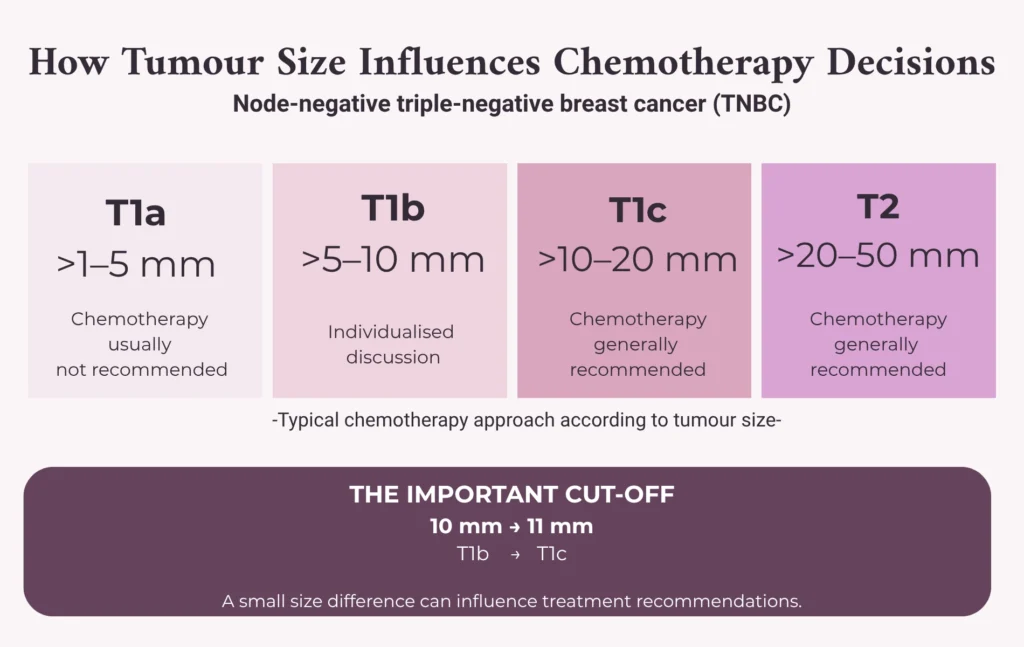
A tumour measuring exactly 10 mm is T1b. At 11 mm, it becomes T1c.
That small difference can influence treatment recommendations.
How good is the prognosis?
The prognosis for very small, node-negative triple-negative breast cancer can be surprisingly favourable.
A large study involving 4,565 patients examined survival according to tumour size and chemotherapy treatment.¹
| Tumour size | Five-year breast cancer-specific survival with chemotherapy | Without chemotherapy |
| T1a | 97.8% | 97.2% |
| T1b | 94.1% | 94.0% |
| T1c | 94.5% | 89.9% |
For T1b disease, there was no statistically significant survival difference between the chemotherapy and non-chemotherapy groups.
This does not prove chemotherapy has no benefit. The study was observational, and treatment selection may have influenced the results.
However, it demonstrates why a 10 mm cancer should not automatically be treated like a much larger tumour.
Four cycles of chemotherapy or six months?
One option is four cycles of docetaxel and cyclophosphamide, commonly called TC, over approximately three months.
Another is a longer regimen containing an anthracycline, such as doxorubicin, followed by paclitaxel.
Both approaches are used in early breast cancer.
More intensive treatment may offer additional benefit in higher-risk disease.
However, we do not have convincing evidence that adding an anthracycline provides a meaningful additional survival advantage specifically for a 10 mm, node-negative triple-negative cancer.
Nor can we claim that the shorter and longer regimens are definitively equivalent in this exact group.
The decision should therefore consider the patient’s baseline recurrence risk, pathology and preferences.
What are the long-term cardiac risks?
This is particularly important for a woman diagnosed at 41 who may live another four decades.
Anthracyclines can damage the heart muscle, sometimes causing heart failure many years after treatment.
A long-term study published in JAMA Network Open reported the following cumulative rates of congestive heart failure.²
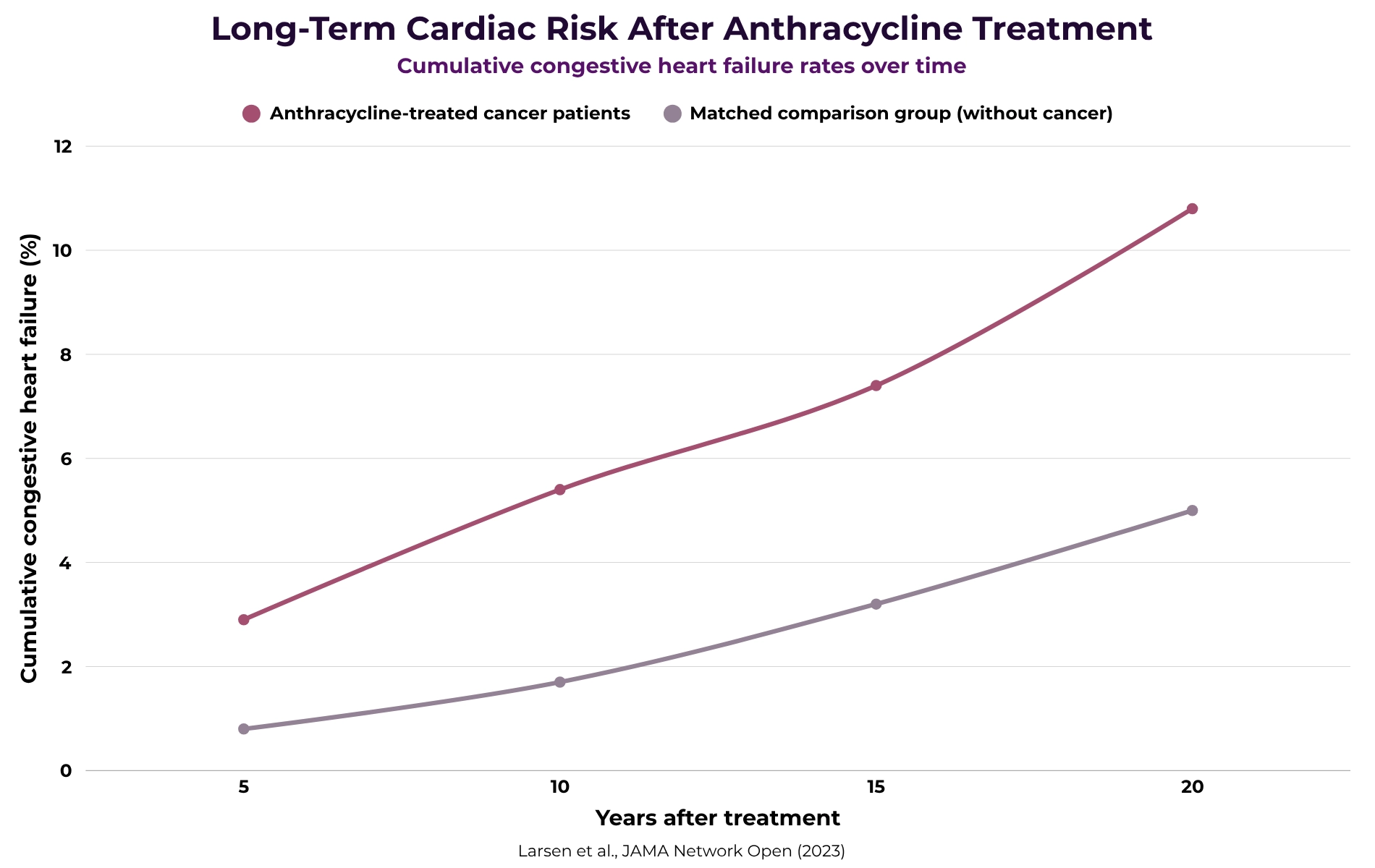
Among anthracycline-treated patients, cumulative congestive heart failure rates increased from 2.9% at five years to 10.8% at 20 years, compared with 0.8% and 5.0%, respectively, in the comparison population. At 10 and 15 years, the corresponding rates were 5.4% and 7.4% in anthracycline-treated patients, compared with 1.7% and 3.2% in the comparison population.
These results included patients treated for breast cancer or lymphoma, with different ages and treatment exposures. They are not the predicted risk for a healthy 41-year-old receiving standard-dose AC.
Nevertheless, they demonstrate that cardiac risk may persist for decades.
These figures concern clinical heart failure, not every asymptomatic reduction in ejection fraction.
What about myelodysplastic syndrome and leukaemia?
Another uncommon but serious complication is treatment-related myelodysplastic syndrome (MDS) or acute myeloid leukaemia (AML).
A large study of more than 150,000 patients with breast cancer reported the following ten-year cumulative risks.³
| Blood disorder | Anthracycline chemotherapy | Non-anthracycline chemotherapy |
|---|---|---|
| Myelodysplastic syndrome | 0.199% | 0.163% |
| Acute myeloid leukaemia | 0.221% | 0.122% |
The absolute risks are small.
However, these conditions can be serious, and the excess risk deserves consideration when the additional benefit of anthracycline treatment is uncertain.
We cannot reliably extrapolate these figures to predict an annual risk over 40 years.
Does triple-negative breast cancer return after five years?
There is encouraging news here.
Unlike hormone receptor-positive breast cancer, which can recur decades later, triple-negative breast cancer has its greatest recurrence risk during the first three to five years.
A study involving 873 patients who had already remained disease-free for five years reported the following results.⁴
| Time from original diagnosis | Remaining free from recurrence | Estimated recurrence |
|---|---|---|
| 10 years | 97% | 3% |
| 15 years | 95% | 5% |
These figures apply to patients who had already reached five years without recurrence, across different initial stages. They are not the recurrence risk from the day of diagnosis.
Nevertheless, they are reassuring.
For patients who remain disease-free at five years, the subsequent risk of triple-negative breast cancer recurrence is relatively low.
Why genetic testing matters
A woman diagnosed with triple-negative breast cancer at 41 should undergo assessment for inherited cancer susceptibility.
In Australia, appropriately trained oncology teams can often arrange genetic testing through mainstream pathways.
BRCA1 and BRCA2 are particularly relevant, alongside other genes selected according to the family history.
An inherited mutation may influence future surveillance, preventive surgery and family counselling.
It does not automatically mean a small, node-negative cancer requires more intensive chemotherapy.
My clinical perspective
For this patient, I would first confirm the exact invasive tumour size, lymph-node findings, surgical margins and final pathology.
I would also arrange germline genetic testing.
If the cancer measures 10 mm or less and the lymph nodes are negative, four cycles of TC would be a reasonable option to discuss if chemotherapy is selected.
For selected T1b patients, observation without chemotherapy is also a legitimate discussion.
I would not automatically recommend six months of anthracycline-containing chemotherapy simply because the cancer is triple-negative.
The objective is not to give the maximum amount of chemotherapy. It is to maximise the chance of cure while minimising unnecessary long-term harm.
Three take-home messages
- A 10 mm, node-negative triple-negative breast cancer can have an excellent prognosis.
- The additional survival benefit of more intensive chemotherapy in very small cancers remains uncertain.
- Long-term cardiac and blood-cancer risks matter, particularly for younger women.
Frequently asked questions
1. Does every triple-negative breast cancer need chemotherapy?
No. Chemotherapy is generally not recommended for T1a cancers, while T1b cancers require individualised assessment. Treatment is more strongly recommended for T1c and larger cancers.
2. Is four cycles of TC enough for a 10 mm cancer?
It may be reasonable for selected patients. The additional benefit of longer anthracycline-containing chemotherapy in this exact setting is uncertain.
3. Can triple-negative breast cancer return after five years?
Yes, but late recurrence is relatively uncommon. Among patients already disease-free at five years, approximately 95% remained free from recurrence at fifteen years in one long-term study.
4. Should younger women with triple-negative breast cancer have genetic testing?
Yes. Genetic assessment is particularly important in younger patients and those with a family history of breast or ovarian cancer.
References
- Zhang J, Wang W, Wang J, et al. Survival outcome and impact of chemotherapy in T1 node-negative triple-negative breast cancer: a SEER database analysis. J Oncol. 2020;2020:8880727. doi:10.1155/2020/8880727.
- Larsen CM, Garcia Arango M, Dasari H, et al. Association of anthracycline with heart failure in patients treated for breast cancer or lymphoma, 1985-2010. JAMA Netw Open. 2023;6(2):e2254669. doi:10.1001/jamanetworkopen.2022.54669.
- Lee JW, Oh H, You JY, et al. Therapy-related myeloid neoplasm in early breast cancer patients treated with adjuvant chemotherapy. Eur J Cancer. 2023;191:112952. doi:10.1016/j.ejca.2023.112952.
- Reddy SM, Barcenas CH, Sinha AK, et al. Long-term survival outcomes of triple-receptor negative breast cancer survivors who are disease free at 5 years and relationship with low hormone receptor positivity. Br J Cancer. 2018;118(1):17-23. doi:10.1038/bjc.2017.379.
Breast cancer second opinions in Melbourne and internationally
Patients seeking a triple-negative breast cancer second opinion in Melbourne may benefit from a detailed review of pathology, tumour stage, genetics and chemotherapy recommendations.
My objective is to ensure patients receive treatment appropriate for their individual cancer while avoiding unnecessary investigations and treatment-related toxicity.
Dr Dilanka De Silva, MBBS, MRCP(UK), MRCP(SCE Oncology), FRACP, PhD
Medical Oncologist and Cancer Genetics Physician
Former Fellow, Memorial Sloan Kettering Cancer Center, New York
Melbourne, Australia
Medical disclaimer: This article provides general educational information and does not replace individual medical advice. The clinical vignette has been anonymised and selected details generalised to protect patient confidentiality.