
Many of my patients have asked for simpler explanations of prostate cancer studies and, more importantly, how those studies actually apply to the person sitting in front of me.
Sometimes a clinical trial gives us an important new treatment.
Sometimes it teaches us something even bigger.
PEACE-3 did both.
Who is this article for?
This article is for men who:
- have recently been diagnosed with metastatic prostate cancer;
- have cancer that has spread mainly or only to the bones;
- have heard about enzalutamide or radium-223;
- want to understand the difference between hormone-sensitive and castration-resistant prostate cancer;
- are wondering how doctors decide which treatment should come first; or
- want to understand how genetic testing may affect future treatment options.
The question
A 62-year-old gentleman recently came to see me for a second opinion after being diagnosed with metastatic prostate cancer.
His PSMA PET scan showed cancer in the prostate and three areas of bone.
Importantly, there was no evidence of spread to the liver or lungs.
He had already undergone a bilateral orchidectomy, meaning both testicles had been removed to permanently lower testosterone.
This is less commonly used in Australia, where hormone injections are usually preferred, but it remains an effective and often very practical way of achieving long-term androgen deprivation in other healthcare systems.
He asked me a very simple question:
“Doctor, if this is going to be a long journey, how do we make sure I don’t run out of treatment options?”
That question is really what this article is about.
The short answer
Modern metastatic prostate cancer treatment is no longer about choosing one “best” medicine.
It is increasingly about choosing the right treatment in the right sequence.
A man newly diagnosed with metastatic prostate cancer may need:
- treatment to keep testosterone very low;
- an additional tablet that blocks prostate cancer growth signals;
- radiotherapy to the prostate in selected men with a small amount of metastatic disease;
- chemotherapy in some patients;
- genetic testing; and
- careful planning for treatments that may become useful later.
PEACE-3 becomes relevant further along that journey, when the prostate cancer has become castration resistant—meaning it is growing despite testosterone already being kept very low.
That distinction is essential.
First, what type of prostate cancer did PEACE-3 study?
PEACE-3 did not study men who had just been diagnosed with metastatic prostate cancer.
It studied men whose prostate cancer had already spread to the bones and had started growing again despite testosterone being suppressed to very low levels.
Doctors call this metastatic castration-resistant prostate cancer, or mCRPC.
The trial included 446 men. They had little or no cancer-related pain, and the cancer had not spread to organs such as the liver or lungs.
They received either:
- enzalutamide alone; or
- enzalutamide plus six treatments of radium-223.
What is radium-223?
Radium-223 is not ordinary chemotherapy.
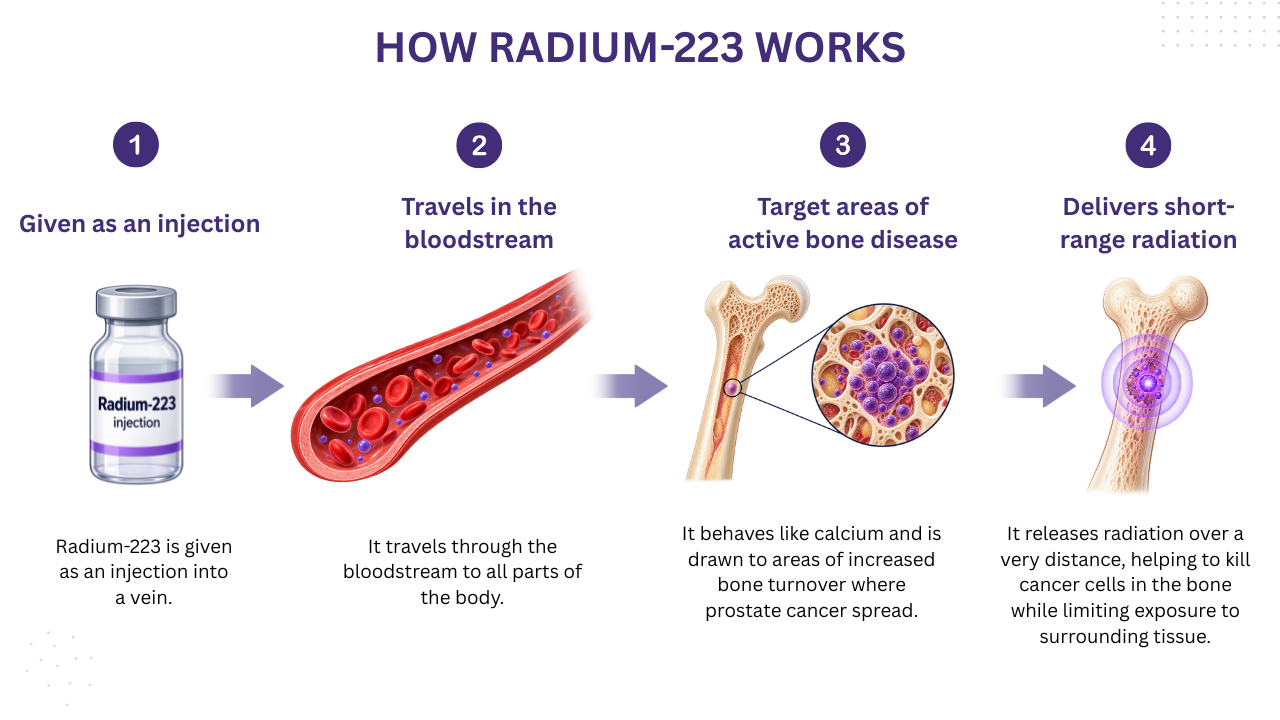
It is a radioactive treatment that behaves a little like calcium.
Areas of prostate cancer in bone often have very active bone turnover, and radium-223 is drawn to these areas.
It then releases radiation over a very short distance.
In simple terms, it delivers radiation directly to areas of prostate cancer in the bones while limiting exposure to much of the surrounding tissue.
This makes it particularly relevant to prostate cancer that is predominantly affecting the skeleton.
What did PEACE-3 actually show?
The first important result was that adding radium-223 kept the cancer controlled for longer on scans.
The median time before the cancer worsened on imaging was:
- 19.4 months with enzalutamide plus radium-223
- compared with 16.4 months with enzalutamide alone.
The median is the midpoint of the study group. Half the patients had longer cancer control and half had shorter cancer control.
The later survival results were even more important.
Median overall survival was:
- 38.2 months with enzalutamide plus radium-223
- compared with 32.6 months with enzalutamide alone.
That is a difference of about 5½ months in median survival.
These are meaningful results, but they apply to the type of patients who were actually enrolled in PEACE-3. They should not automatically be applied to every man with metastatic prostate cancer.
One of the most important lessons was actually about bone protection
This is a part of PEACE-3 that I think patients should understand.
Men with metastatic prostate cancer can have weaker bones because:
- prostate cancer itself may affect the skeleton;
- long-term hormone treatment can reduce bone density;
- age can increase fracture risk; and
- some treatments can add further stress to the bones.
During PEACE-3, doctors began routinely using medicines such as denosumab or zoledronic acid to strengthen the bones and reduce fracture risk.
Use of these medicines increased from about 46 in every 100 patients to 97 in every 100.
The difference was striking.
Among men receiving enzalutamide alone, the one-year fracture rate fell from about:
- 16 in every 100 without routine bone protection
- to about 3 in every 100 when a bone-protecting medicine was used.
For me, this is an important practical message: if radium-223 is being considered, protecting the bones is part of the treatment—not an optional extra.
Would my patient actually fit PEACE-3?
Not at this stage.
This is exactly why his case is so interesting.
He had newly diagnosed metastatic hormone-sensitive prostate cancer.
That means his cancer was still expected to respond to treatment that lowers or blocks testosterone.
PEACE-3 studied men later in the disease journey, after the cancer had started growing despite very low testosterone levels.
So his treatment today should be based on evidence for hormone-sensitive metastatic prostate cancer—not PEACE-3.
But PEACE-3 may become relevant later if his cancer eventually becomes castration resistant and remains mainly in the bones.
This is where long-term planning becomes important.
Why modern treatment begins much earlier
Several years ago, androgen deprivation alone was commonly used as the main first treatment for metastatic prostate cancer.
That has changed.
For many suitable men, simply lowering testosterone is no longer enough. We now often add another effective treatment earlier.
Depending on the clinical situation, this may include an androgen-receptor pathway inhibitor, which is a tablet that blocks the signals prostate cancer cells use to respond to male hormones. Chemotherapy may also be appropriate for selected patients.
Modern metastatic prostate cancer treatment usually involves more than testosterone suppression alone, with the exact combination individualised for each patient.
The exact strategy depends on:
- whether the disease is high or low volume;
- whether it was metastatic at the time of diagnosis;
- symptoms;
- general health;
- previous treatments;
- tumour biology;
- genetic findings; and
- the patient’s priorities.
What do the different prostate cancer treatments actually do?
| Treatment | What it does | When it may be relevant |
| Androgen deprivation | Keeps testosterone very low | Foundation of treatment for metastatic hormone-sensitive prostate cancer |
| Androgen-receptor pathway inhibitor | Blocks signals prostate cancer cells use to grow | Often added early to improve cancer control |
| Chemotherapy | Attacks rapidly dividing cancer cells throughout the body | Considered for selected patients depending on disease features, general health and previous treatment |
| Prostate radiotherapy | Treats the original prostate tumour | Particularly relevant for selected men with low-volume newly diagnosed metastatic disease |
| Radium-223 | Delivers targeted radiation to areas of prostate cancer in bone | May be considered for selected men with bone-predominant castration-resistant disease |
| PARP inhibitor | Targets cancers with certain DNA-repair defects | May be appropriate for selected patients whose cancer has a relevant genetic change |
Should the prostate still be treated if the cancer has already spread?
Sometimes, yes.
This surprises many patients.
In selected men with a relatively small amount of metastatic disease, radiotherapy to the prostate can improve survival.
The STAMPEDE trial showed that, at three years:
- about 81 in every 100 men who received prostate radiotherapy were alive;
- compared with about 73 in every 100 men who received standard systemic treatment alone.
This means that treating the prostate still made a meaningful difference for this carefully selected group, even though the cancer had already spread.
The same benefit was not seen in men with a larger amount of metastatic disease.
Why orchidectomy is still a reasonable treatment
Some patients are surprised when they hear that surgical removal of the testicles is still used for metastatic prostate cancer.
The purpose of both orchidectomy and hormone injections is essentially the same:
to reduce testosterone to very low levels.
Orchidectomy achieves this permanently.
Hormone injections achieve it medically and are reversible to varying degrees once they are stopped.
In Australia, injections are more commonly used.
However, orchidectomy can remain an effective and practical option, particularly in healthcare systems where long-term injections may be difficult or expensive.
It should not be viewed as an inferior treatment simply because it is older.
The important question is whether testosterone has been effectively suppressed and whether the broader treatment strategy is appropriate.
What about genetic testing?
PEACE-3 did not require men to have a BRCA1 or BRCA2 mutation.
But genetic testing is still an important part of modern metastatic prostate cancer care.
Current guidelines recommend inherited genetic testing for men with metastatic prostate cancer.
This is sometimes called germline testing.
It looks for gene changes that a person was born with and that may also be relevant to close family members.
We may also test the cancer itself. This is called tumour or somatic testing.
Why does this matter?
Changes in genes such as BRCA1 or BRCA2 may make some patients eligible for treatments called PARP inhibitors.
So genetic testing may affect both:
- future treatment options for the patient; and
- cancer-risk information for the family.
This is why genetics is no longer an optional extra in metastatic prostate cancer care.
Has treatment moved faster than PEACE-3?
PEACE-3 is not outdated.
It remains an important study and provides useful evidence for selected men with castration-resistant prostate cancer affecting the bones.
What has changed is the treatment patients may have received before they reach that stage.
When PEACE-3 began enrolling patients, medicines such as enzalutamide were often used later in the prostate cancer journey.
Today, many men receive similar androgen-receptor-targeted treatments much earlier, while the cancer is still hormone sensitive.
As a result, a patient who develops castration-resistant disease today may arrive at that point having already received treatments that many PEACE-3 participants had not received earlier.
That does not make PEACE-3 less important. It means we have to interpret the trial in the context of the individual patient’s previous treatment.
The treatment journey matters
When I started oncology training, we often focused on finding the single best drug.
Today, I think differently.
There is no single sequence that applies to every patient.
Depending on the individual patient, the treatment journey may include some of the following:
Earlier in the metastatic treatment journey
Androgen deprivation
↓
An androgen-receptor pathway inhibitor
↓
Prostate radiotherapy if appropriate
↓
Chemotherapy in selected situations
If the cancer later becomes resistant
A different systemic treatment
↓
Radium-223 in selected bone-predominant disease
↓
PARP-directed treatment when an actionable genetic alteration is present
↓
Other systemic or radioligand treatments depending on previous therapy and disease biology
This is not a fixed sequence.
Different patients will follow different paths.
But the principle is important:
Every good treatment decision should also consider what options it preserves for later.
What would I usually consider?
When I meet someone with newly diagnosed metastatic prostate cancer, I try to answer a few important questions.
- Is the cancer still responding to testosterone suppression?
- How much cancer is present, and where has it spread?
- Would adding another hormone-blocking medicine improve long-term control?
- Would chemotherapy add enough benefit to justify the side effects?
- Would radiotherapy to the prostate help?
- Has inherited genetic testing been performed?
- Could tumour genetic testing identify a treatment option for later?
And perhaps most importantly:
“If we choose this treatment now, what options will we still have available later?”
The aim is not simply to find the next medicine.
It is to build the right treatment roadmap for that individual patient.
What does this mean for patients in Australia?
Australian patients have PBS access to several important prostate cancer medicines in defined clinical settings.
Medicines such as enzalutamide, apalutamide and abiraterone are PBS-subsidised for eligible patients, although the exact criteria depend on the stage of disease and previous treatment.
PBS eligibility changes over time and should always be checked when a treatment is being planned.
Access to radium-223 also needs to be considered according to the current Australian funding and clinical setting.
What this means for you
If you have metastatic prostate cancer:
- Do not judge your treatment plan by one clinical trial alone.
- Ask whether your cancer is still hormone sensitive or has become castration resistant.
- Ask whether treatment to the prostate itself is relevant if you have low-volume newly diagnosed metastatic disease.
- Make sure genetic testing has been discussed.
- Ask how today’s treatment choice may affect the options available later.
The exact sequence will be different for every patient.
The one message I want patients to remember
PEACE-3 is an important trial.
It showed that, in carefully selected men with bone-predominant metastatic castration-resistant prostate cancer, adding radium-223 to enzalutamide improved both cancer control and overall survival.
But the broader lesson is even more important.
Modern prostate cancer care is increasingly about the whole treatment journey.
When patients ask me:
“What is the best prostate cancer treatment?”
my answer is increasingly:
There isn’t one treatment. There is a treatment pathway.
Every decision should aim to control the cancer today while preserving the best opportunities for tomorrow.
Key take-home messages
- PEACE-3 studied men with metastatic castration-resistant prostate cancer affecting the bones—not men newly diagnosed with hormone-sensitive metastatic disease.
- Adding radium-223 to enzalutamide improved median overall survival from 32.6 to 38.2 months in the trial population.
- Bone-protecting treatment substantially reduced fracture risk and is an important part of treatment when radium-223 is used.
- For selected men with a relatively small amount of newly diagnosed metastatic disease, radiotherapy to the prostate can still improve survival.
- Modern prostate cancer care is increasingly about choosing treatments in the right sequence and preserving future options.
Key evidence
- Tombal B, Choudhury A, Saad F, et al. Enzalutamide plus radium-223 in metastatic castration-resistant prostate cancer: results of the EORTC 1333/PEACE-3 trial. Ann Oncol. 2025;36(9):1058-1067. doi:10.1016/j.annonc.2025.05.011
- Gillessen S, Gallardo E, Choudhury A, et al. Final overall survival results from EORTC 1333/PEACE-3 trial of enzalutamide plus radium-223 in metastatic castration-resistant prostate cancer. Ann Oncol. 2026;37(5):736-742. doi:10.1016/j.annonc.2026.02.009
- Gillessen S, Tombal B, Turco F, et al. Decrease in fracture rate with mandatory bone-protecting agents in the EORTC 1333/PEACE-3 trial comparing radium-223 combined with enzalutamide versus enzalutamide alone: a safety analysis. Eur Urol. 2025;87(3):285-288. doi:10.1016/j.eururo.2024.11.027
- Parker CC, James ND, Brawley CD, et al. Radiotherapy to the primary tumour for newly diagnosed, metastatic prostate cancer (STAMPEDE): a randomised controlled phase 3 trial. Lancet. 2018;392(10162):2353-2366. doi:10.1016/S0140-6736(18)32486-3
- Yu EY, Rumble RB, Agarwal N, et al. Germline and somatic genomic testing for metastatic prostate cancer: ASCO guideline. J Clin Oncol. 2025;43(6):748-758. doi:10.1200/JCO-24-02608
- Taplin ME, Riaz IB, Rumble RB, et al. Systemic therapy in patients with metastatic castration-resistant prostate cancer: ASCO living guideline, version 2026.1. J Clin Oncol. 2026;44(6):e1-e14. doi:10.1200/JCO-25-02693
Frequently asked questions (FAQs)
What does it mean when prostate cancer becomes castration resistant?
It means the cancer has started growing again, even though testosterone has already been reduced to very low levels.
If the cancer has also spread elsewhere in the body, doctors call this metastatic castration-resistant prostate cancer, or mCRPC.
Is radium-223 chemotherapy?
No.
Radium-223 is a targeted radioactive treatment that travels to areas of active bone turnover, including many prostate cancer deposits in bone.
Did PEACE-3 show that every patient with bone metastases should receive radium-223?
No.
PEACE-3 studied a selected group of men with mCRPC, bone metastases, little or no cancer-related pain, and no cancer spread to organs such as the liver or lungs.
Treatment must still be individualised.
Why are bone-protecting medicines important?
Both metastatic prostate cancer and its treatments can weaken bone.
PEACE-3 showed a substantial reduction in fractures after bone-protecting treatment became routinely required.
If my prostate cancer has spread, should the prostate still be treated?
For selected men with newly diagnosed low-volume metastatic disease, prostate radiotherapy has been shown to improve survival.
It is not beneficial in the same way for every man with metastatic disease.
Does every man with metastatic prostate cancer need genetic testing?
Current ASCO guidance recommends inherited genetic testing, also called germline testing, for all patients with metastatic prostate cancer.
Does PEACE-3 apply to someone who already received enzalutamide or another ARPI earlier?
Not necessarily in exactly the same way.
Many patients now receive androgen-receptor pathway inhibitors during the hormone-sensitive phase. Their treatment history may therefore differ from many patients enrolled when PEACE-3 began.
That is why trial results need to be interpreted in the context of the individual’s previous treatments.
Dr Dilanka De Silva
MBBS, MRCP(UK), MRCP(UK SCE Oncology), FRACP, PhD
Medical Oncologist & Cancer Genetics Physician
Memorial Sloan Kettering Cancer Center Fellow (New York, USA)