
Why the HARMONi studies and a new treatment called ivonescimab could change the future of lung cancer care.
Who This Is For
This article is particularly relevant if:
- You have advanced lung cancer and have been told that your cancer does not have a mutation suitable for targeted treatment.
- You have EGFR-mutated lung cancer and have responded well to a targeted medication such as osimertinib (Tagrisso), but your cancer is now beginning to grow again.
- You have been offered chemotherapy or immunotherapy and want to understand the latest treatment developments.
- You are looking for a second opinion about newer lung cancer treatments or clinical trials.
Some of the most exciting developments in lung cancer treatment are now coming from China.
A new medicine called ivonescimab is attracting considerable international attention because several major clinical studies have shown that it can help patients live longer.¹⁻⁴
For patients with advanced lung cancer, this is particularly encouraging.
A 75-Year-Old Patient Whose Lung Cancer Has Started Growing Again
Imagine a 75-year-old gentleman diagnosed with advanced lung cancer two and a half years ago.
His cancer was found to have an EGFR mutation. This meant he could receive a targeted medication called osimertinib.
He responded remarkably well.
For two and a half years, his cancer remained under excellent control. He continued enjoying life, spending time with his family and maintaining his independence.
Unfortunately, his latest CT scan now shows that the cancer is beginning to grow again.
He asks me a very important question:
“Doctor, my treatment has worked beautifully for two and a half years. Now that the cancer is growing again, what can we do?”
This is a situation that oncologists encounter regularly.
The encouraging news is that there are several treatment options after osimertinib stops working.
Sometimes we can identify a new mutation that allows us to use another targeted treatment. Sometimes radiotherapy can control a small number of growing lesions.
For patients requiring a change in systemic treatment, newer combinations and clinical trials are creating additional opportunities.
One of the most interesting developments is a new group of medicines called bispecific antibodies.
What Is This New Treatment?
The medicine is called ivonescimab.
It belongs to a group of treatments known as bispecific antibodies.
Although the name sounds complicated, the idea is remarkably simple.
Cancer relies on a blood supply to grow. It also develops ways of hiding from our immune system.
This new medicine attempts to tackle both problems simultaneously.
First, it interferes with the cancer’s blood supply.
It blocks a signal called VEGF, which helps cancers develop new blood vessels.
Second, it helps the immune system fight the cancer.
It blocks a signal called PD-1, which cancers can exploit to prevent immune cells from attacking them.
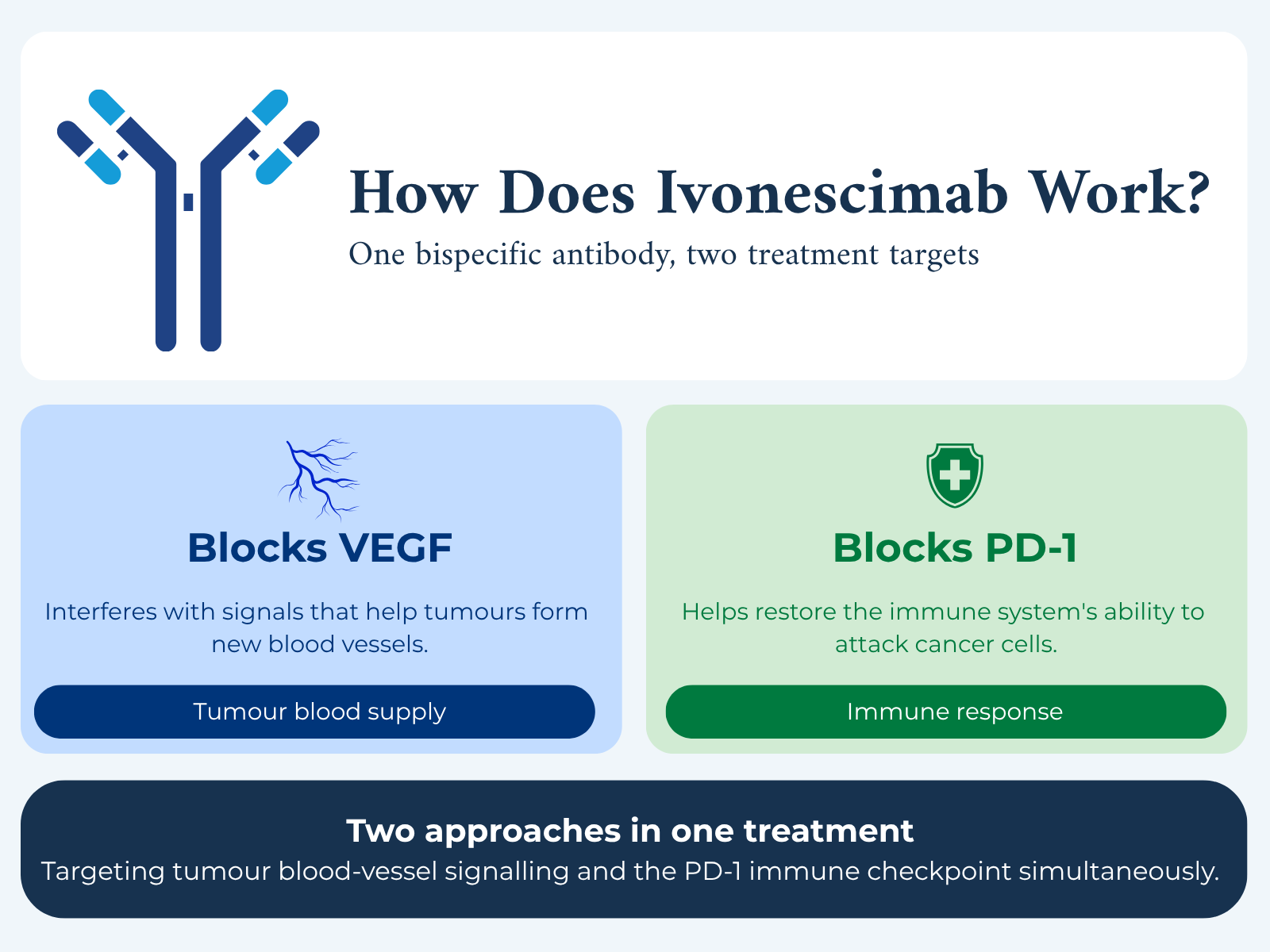
In other words, one antibody combines two different treatment approaches.
The particularly interesting possibility is that these two mechanisms may work better together than either approach alone.
Why This Surprised Me
For many years, blocking the blood supply to cancer was considered one of the most promising approaches in oncology.
We knew that these treatments could delay cancer growth.
However, there was a major problem.
Delaying cancer progression did not always translate into patients living longer.
This is an important distinction.
When we evaluate cancer treatments, we are interested in two main outcomes.
The first is how long a treatment controls the cancer before it begins growing again. This is called progression-free survival.
The second is how long patients actually live. This is called overall survival.
For me, overall survival is one of the most important outcomes.
What surprised me about the HARMONi studies was that researchers were beginning to demonstrate improvements in overall survival, rather than simply delaying cancer progression.¹⁻³
The Chinese research programme has been particularly impressive.
China has moved ahead of much of the world in developing this specific type of antibody and generating large clinical trials.
The results are now attracting considerable international interest.
What Have the HARMONi Studies Shown?
Several studies have investigated ivonescimab in different groups of patients with advanced lung cancer.
The results are encouraging.
| Study | Patients studied | Time before cancer progressed | Overall survival |
|---|---|---|---|
| HARMONi-2 | First-line lung cancer without EGFR or ALK mutations | 11.1 vs 5.8 months | 30.8 vs 22.6 months |
| HARMONi-6 | First-line squamous lung cancer | 11.1 vs 6.9 months | 27.9 vs 23.7 months |
| HARMONi-A | EGFR-mutated lung cancer after targeted treatment | 7.1 vs 4.8 months | 16.8 vs 14.1 months |
| Global HARMONi | EGFR-mutated lung cancer after third-generation EGFR treatment | 6.8 vs 4.4 months | 16.8 vs 14.0 months |
Sources: HARMONi-2, HARMONi-6, HARMONi-A and global HARMONi studies.¹⁻⁴
Numbers compare ivonescimab-based treatment with the standard comparison treatment in each study. Figures represent median survival, not an individual patient’s expected lifespan. The global HARMONi trial showed improved cancer control, but its primary overall survival analysis did not reach the required statistical threshold.⁴,⁵
In HARMONi-2, patients receiving ivonescimab lived approximately eight months longer at the median than those receiving pembrolizumab, an established immunotherapy medicine.¹
In HARMONi-6, patients receiving ivonescimab with chemotherapy also experienced a meaningful improvement in survival.²
These results suggest that this new approach could become an important part of first-line lung cancer treatment.
The Most Exciting Finding: The Longer Survival Tail
There is another result that I find particularly interesting.
When we look at survival after cancer treatment, we do not simply want to know whether the average patient lives another two or three months.
We want to know whether more patients remain alive several years later.
In oncology, this is sometimes called the tail of the survival curve.
The Chinese HARMONi-A study provides an encouraging example.
Among patients with EGFR-mutated lung cancer whose previous targeted treatment had stopped working:
- 29 out of 100 patients receiving ivonescimab with chemotherapy were alive at 30 months.
- 18 out of 100 patients receiving chemotherapy alone were alive at 30 months.
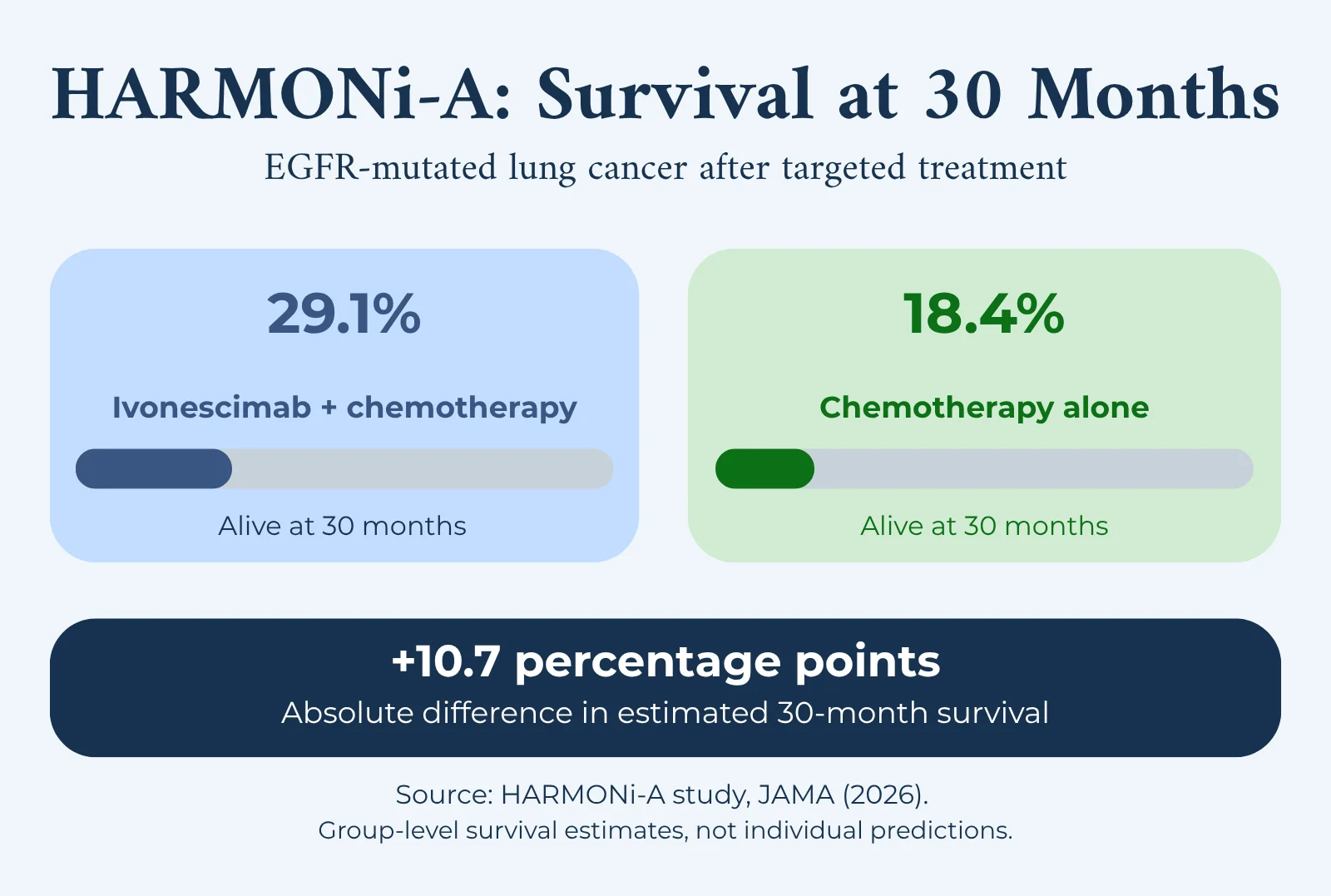
That is approximately 11 additional patients alive for every 100 treated at that time point.³
For patients and families, this is a meaningful difference.
It suggests that the new treatment may increase the proportion of patients who experience longer survival.
This is why I find the results particularly encouraging.
What Would I Recommend for Our 75-Year-Old Patient?
Let us return to our gentleman whose lung cancer has started progressing after two and a half years of osimertinib.
My first step would be to carefully review his latest scans.
If only one or two areas are growing, focused radiotherapy may allow him to continue benefiting from osimertinib.
If the cancer is progressing more widely, I would consider repeating molecular testing.
This is important because lung cancer can develop new genetic changes that allow it to become resistant to treatment.
Sometimes these changes provide an opportunity to use another targeted medicine.
If there is no suitable new target, we have other treatment options.
These include chemotherapy and newer combinations involving medicines such as amivantamab.
The HARMONi studies have now introduced another potentially important approach: combining chemotherapy with a bispecific antibody that targets both VEGF and PD-1.
For a patient who has enjoyed two and a half years of excellent disease control, I would be particularly interested in treatments that offer the possibility of extending survival while preserving quality of life.
The decision would depend on his overall health, the extent of progression, molecular test results and available treatments.
The important message is simple.
Progression after osimertinib does not mean that treatment options have been exhausted.
What About Lung Cancer Without a Targetable Mutation?
This is another area where the results are particularly exciting.
For patients without EGFR, ALK or another actionable mutation, immunotherapy has already transformed the treatment of advanced lung cancer.
Pembrolizumab, commonly known as Keytruda, is one of the most widely used treatments.
However, the HARMONi-2 study directly compared ivonescimab with pembrolizumab in selected patients receiving their first treatment for advanced lung cancer.
Patients receiving ivonescimab experienced better cancer control and longer overall survival.¹
The HARMONi-6 study also showed encouraging survival results when ivonescimab was combined with chemotherapy in squamous lung cancer.²
These studies raise the possibility that bispecific antibodies could become an important first-line treatment option for patients without actionable mutations.
For patients with ALK-mutated lung cancer, targeted medicines remain the main treatment approach, and we need further evidence to establish whether these newer antibodies offer similar benefits.
Three Things I Hope You Remember
1. Lung cancer treatment does not end when the first treatment stops working.
There may be opportunities for further targeted treatment, chemotherapy, radiotherapy, newer combinations or clinical trials.
2. Bispecific antibodies represent an exciting development.
By combining immune treatment with interference in the cancer’s blood supply, researchers are beginning to demonstrate meaningful improvements in survival.
3. The most important decision is choosing the right treatment for your particular cancer.
Molecular testing, previous treatment, overall health and access to new therapies all matter.
My Final Thoughts
Lung cancer treatment has changed enormously over the past decade.
Patients who previously had limited options can now sometimes experience several years of excellent disease control.
The emergence of bispecific antibodies represents another potentially important development.
What particularly excites me is that researchers are now demonstrating improvements in overall survival, including encouraging longer-term survival results in patients whose cancers have progressed after targeted treatment.
The HARMONi studies may influence how we treat advanced lung cancer over the coming years.
For patients and families, the message is encouraging.
Even when a treatment stops working, there may still be meaningful opportunities ahead.
Frequently Asked Questions
1. My lung cancer is growing again after Tagrisso. Are there other treatments?
Yes. Options include repeat molecular testing to identify resistance mutations, radiotherapy for limited progression, chemotherapy, amivantamab-based combinations and clinical trials. New treatments such as ivonescimab are also showing encouraging results.
2. Is ivonescimab better than Keytruda for lung cancer?
In the HARMONi-2 study, ivonescimab improved survival compared with Keytruda in selected patients receiving their first treatment for advanced lung cancer. This is an encouraging development for patients without actionable mutations.
3. Can ivonescimab help patients with EGFR-mutated lung cancer?
Yes, clinical studies have shown promising benefits after EGFR-targeted treatment stops working. In HARMONi-A, ivonescimab combined with chemotherapy improved overall survival compared with chemotherapy alone.
4. Can I access new lung cancer treatments if I live in Sri Lanka, Indonesia, the Philippines or Maldives?
Treatment options depend on local availability, approvals and clinical trial access. An international oncology second opinion can help identify established treatments, newer medicines and appropriate clinical trials in your country or overseas.
Scientific References
- Zhou C. Overall survival analysis from HARMONi-2: ivonescimab vs pembrolizumab as first-line treatment for PD-L1-positive NSCLC. Presented at: IASLC 2026 World Conference on Lung Cancer; September 12-15, 2026; Seoul, Republic of Korea. Abstract OA14.01. IASLC conference results
- Lu S, Liu B, Luo Y, et al. Ivonescimab plus chemotherapy versus tislelizumab plus chemotherapy in advanced squamous non-small-cell lung cancer (HARMONi-6): interim overall survival analysis of a randomised, double-blind, phase 3 trial in China. Lancet. 2026;407(10548):2620-2629. doi:10.1016/S0140-6736(26)00966-9
- Fang W, Zhao Y, Luo Y, et al. Bispecific antibody ivonescimab added to chemotherapy in EGFR-variant non-small cell lung cancer: the HARMONi-A randomized clinical trial. JAMA. 2026;336(4):306-314. doi:10.1001/jama.2026.7745
- Le X, et al. Ivonescimab plus chemotherapy versus placebo plus chemotherapy in patients with advanced EGFR-mutated non-small-cell lung cancer after disease progression on EGFR tyrosine kinase inhibitor therapy (HARMONi): a multicentre, randomised, double-blind, phase 3 trial. Lancet Oncol. 2026;27(9):1094-1109. doi:10.1016/S1470-2045(26)00282-2
- Summit Therapeutics. Updated HARMONi data presented at WCLC 2026 demonstrate consistent overall survival results with ivonescimab plus chemotherapy in Western and Asian patients. Published September 15, 2026. Company announcement
International Cancer Second Opinions
SloanMaccallum Cancer Services | Melbourne, Australia
Learn more about our lung cancer treatment services in Melbourne.
We provide personalised cancer second opinions for patients across Australia and internationally, including Colombo and other regions of Sri Lanka, Indonesia, the Philippines and Maldives.
Our international oncology service includes reviewing pathology, scans, molecular testing, previous treatments and suitable clinical trials.
Treatment recommendations are tailored to each patient’s diagnosis, circumstances and available treatment pathways, whether care is delivered locally or in Australia.
Dr Dilanka De Silva
MBBS, MRCP (UK), FRACP, PhD
Medical Oncologist and Cancer Genetics Specialist
Former Memorial Sloan Kettering Cancer Center Fellow, USA
This article provides general medical education. Individual treatment decisions require assessment by a qualified oncology specialist.