
Who this is for
If you’ve been told your lung cancer is “HER2-positive,” this explains why that result alone may not tell the full story — and why understanding the detail behind the test can change what happens next.
Two patients can both be told they have “HER2-positive lung cancer,” yet their treatment paths can be very different.
That’s not a mistake — it’s because the label is only the starting point.
What really matters is understanding the cancer at a molecular level, through the right testing at the beginning.
In some cases, that difference can mean moving from months to years — and that is why getting this right early matters.
A quick note about why this matters to me
HER2-positive lung cancer is an area I’ve worked on closely over many years.
During my PhD and clinical training — including time at Memorial Sloan Kettering Cancer Center— I was involved in research and clinical work focused on HER2-driven cancers, including participation in practice-changing studies in this space.
In my current practice in Melbourne, this means that when I see a HER2 result, I don’t take it at face value.
I look carefully at:
• how the test was done
• what type of HER2 alteration is present
• and whether anything may have been missed
Because in lung cancer, those details often determine whether treatment works as well as it should.
Why HER2 is simpler in other cancers
In breast cancer:
• HER2 testing is usually straightforward
• protein testing (IHC) aligns well with treatment decisions
• one or two tests are often enough
👉 The label usually reflects the biology.
Why HER2 is different in lung cancer
In lung cancer, HER2 behaves differently.
There are three main ways HER2 can be abnormal:
• HER2 mutation (a change in the gene itself)
• HER2 amplification (extra copies of the gene)
• HER2 overexpression (increased protein on the cell surface)
These do not always occur together.
So two patients can both be labelled “HER2-positive”
but have very different underlying biology — and therefore different treatment options.
The three-layer HER2 framework
To understand HER2 in lung cancer, it helps to think of it in three simple layers:
1. Protein level (IHC)
How much HER2 is present on the surface of the cancer cells
2. Gene copy number (FISH)
How many copies of the HER2 gene the cancer has
3. Gene mutation (NGS)
Whether the HER2 gene itself is changed in a way that drives the cancer
👉 These layers do not always match.
That is why relying on a single test can sometimes give an incomplete picture.
Why one test is often not enough
If only one type of test is performed:
• a HER2 mutation may be missed
• amplification may be overinterpreted
• treatment may not match the biology
This is one of the key reasons HER2-targeted treatment in lung cancer has evolved more slowly than in breast cancer.
What actually matters for treatment
Treatment decisions depend on which type of HER2 change is present:
• HER2 mutations → strongest evidence for targeted therapies
• HER2 overexpression → less predictable benefit
• HER2 amplification → variable response
More on how this affects treatment decisions:
→ HER2-positive lung cancer: why the test result alone is not enough
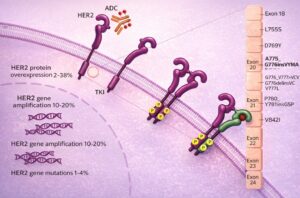
HER2-positive lung cancer is not a single disease — it is a group of cancers defined by different types of HER2 alterations
Why testing at the beginning changes everything
In modern lung cancer care, testing is not an optional step.
It is the starting point.
In my practice in Melbourne Australia, comprehensive molecular testing (NGS) is done upfront — because missing the underlying biology can change the entire treatment pathway.
If testing is incomplete:
• treatment may be less effective
• targeted options may be delayed
• decisions may need to be revisited later
More on this here:
→ Why molecular testing at the beginning can change the entire course of lung cancer
Study context (HER2-targeted therapy)
• Antibody–drug conjugates such as trastuzumab deruxtecan
• Studied mainly in HER2-mutant lung cancer
• Patients often previously treated
Results (key points)
• Response rates ~55–60%
• Median progression-free survival ~8–10 months
• Durable responses seen in a subset of patients
Interpretation:
These results describe the average.
But, as seen across targeted therapies, a smaller group of patients do significantly better — achieving longer and more durable control.
This reflects what we describe as:
👉 “lifting the tail” of the curve
→ Why some patients do far better than expected (tail of the curve concept)
Why second opinions matter here
For many patients — particularly from Sri Lanka, the Maldives, Indonesia, and the Philippines — the challenge is not access to treatment.
It is:
• whether full molecular testing was done
• whether the result was interpreted correctly
• whether treatment matches the biology
A second opinion in this setting often doesn’t change everything — but it can ensure the right test has been done and that the treatment plan truly matches the biology.
It simply ensures that the starting point is correct — and in lung cancer, that starting point matters more than most people realise.
The bigger picture
HER2-positive lung cancer is not one disease.
It is a group of biologically different cancers sharing the same label.
Two patients may look similar on a scan.
But if the biology is different —
the treatment, and the outcome, can be very different.
And that difference begins with understanding more than just the test result.
Key Takeaway
• HER2-positive lung cancer can involve mutations, amplification, or protein overexpression — and these are not the same.
• A single test is often not enough; comprehensive molecular testing (NGS) is essential.
• The best outcomes come from matching the right treatment to the specific biology — not the label alone.
Frequently Asked Questions
1. “My report says HER2-positive — is that enough to choose treatment?”
Not always. In lung cancer, HER2 can mean different things. The key question is whether you have a HER2 mutation, which usually requires detailed molecular testing (NGS). The label alone is often not enough.
2. “How do I know if the right test was done?”
Ask if you had comprehensive molecular testing (NGS) at the start. Some tests only look at protein levels, which can miss important gene changes.
3. “Can this really change how long I live?”
Absolutely. Identifying the right molecular change early can open the door to targeted treatments — and for some patients, that can mean living significantly longer.
4. “Should I get a second opinion?”
If you’re unsure what type of HER2 change you have, or whether full testing was done, a second opinion can help confirm that the treatment plan matches the biology.
Key Evidence
• Li BT, et al. Trastuzumab deruxtecan in HER2-mutant NSCLC. N Engl J Med. 2022;386:241–251.
• Smit EF, et al. Trastuzumab deruxtecan in HER2-overexpressing NSCLC. J Clin Oncol. 2023;41:351–361.
• NCCN Guidelines. Non–Small Cell Lung Cancer. Version 2024.
• ESMO Guidelines Committee. Metastatic NSCLC: molecular testing recommendations. Ann Oncol. 2023.
• De Silva D. Why molecular testing at the beginning can change the entire course of lung cancer treatment. Sloanmaccallum Cancer Care.
• De Silva D. Lifting the tail: how immunotherapy changed long-term survival in advanced cancer. Sloanmaccallum Cancer Care.
• Sloanmaccallum Cancer Care. About our practice and clinical team.
• De Silva D. Precision Medicine in Breast and Thoracic Oncology. PhD thesis. University of Melbourne; 2023.
• Memorial Sloan Kettering Cancer Center. Clinical research and publications: Dr Dilanka De Silva. MSKCC Synapse.
• Li BT, et al. Trastuzumab deruxtecan in HER2-mutant NSCLC. N Engl J Med. 2022;386:241–251.
• Smit EF, et al. Trastuzumab deruxtecan in HER2-overexpressing NSCLC. J Clin Oncol. 2023;41:351–361.
• NCCN Guidelines. Non–Small Cell Lung Cancer. Version 2024.
• ESMO Guidelines Committee. Metastatic NSCLC: molecular testing recommendations. Ann Oncol. 2023.