
Who this is for
If you’ve been told your lung cancer is “HER2-positive,” this explains why that result alone is often not enough to guide treatment — and why understanding the detail behind the test can change what happens next.
Most patients hear “HER2-positive” and assume it means the same thing as in breast cancer.
It doesn’t.
In lung cancer, I often see two patients given the same label — HER2-positive — but their treatment journeys can look completely different.
That’s because the label is only the starting point.
What really matters is understanding the cancer in more detail through proper molecular testing right at the beginning. Identifying the driver changes everything
If we rely on the label alone, we risk choosing the wrong treatment early — and that decision can affect everything that follows.
A quick note about why this matters to me
HER2-positive lung cancer is an area I’ve worked on closely over many years.
During my PhD and subsequent clinical training — including time at Memorial Sloan Kettering Cancer Center — I was involved in research and clinical work focused on HER2-driven cancers, including participation in practice-changing studies in this space.
In day-to-day practice in treatment of lung cancer in Melbourne Australia, this means that when I see a HER2 result, I don’t just see a label.
I look carefully at:
• how that result was obtained
• what type of HER2 alteration is present
• and whether additional molecular testing is needed
Because in this setting, those details are often what determine whether treatment works well — or not as well as it could.
If you would like more detail about my background:
→ About Dr Dilanka De Silva
What does HER2-positive lung cancer actually mean?
HER2 (also called ERBB2) is a growth signal that helps cells divide.
In lung cancer, it can become abnormal in three different ways:
• A mutation in the HER2 gene
• Amplification (extra copies of the gene)
• Protein overexpression (higher levels on the cell surface)
These are not interchangeable.
They are three different biological situations that happen to share the same name.
The three-layer HER2 framework (this is the key)
When assessing HER2 in lung cancer, it helps to think in layers:
Layer 1: Protein (IHC)
• Measures how much HER2 is on the surface
Layer 2: Gene copy number (FISH / amplification)
• Measures how many copies of the HER2 gene are present
Layer 3: Mutation (NGS)
• Detects activating changes in the gene itself
👉 These layers often do not overlap.
And this is where confusion arises.
Why the test result alone is not enough
In breast cancer:
• HER2 protein expression usually reflects the biology
• one test is often sufficient
In lung cancer:
• HER2 mutations can exist without overexpression
• amplification does not always predict response
• a single test can miss the true driver
So when a patient is told:
👉 “Your cancer is HER2-positive”
The more important question becomes:
👉 Which type of HER2 alteration is present?
Without that clarity, treatment decisions can be incomplete.
Why this matters for treatment
Treatment depends on the biology — not the label.
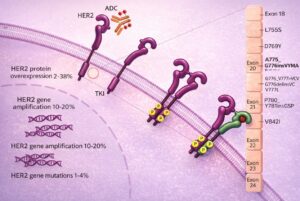
For example:
• HER2 mutations → strongest evidence for targeted therapy and antibody–drug conjugates
• HER2 overexpression → less predictable benefit
• HER2 amplification → variable and often less consistent response
This is why HER2 in lung cancer has historically been more complex than in other cancers.
Study tested (trastuzumab deruxtecan)
• Antibody–drug conjugate targeting HER2
• Studied in HER2-mutant non-small cell lung cancer
• Many patients had received prior treatments
Results
• Response rate ~55–60%
• Median progression-free survival ~8–10 months
• Median duration of response ~9–10 months
Interpretation:
These numbers describe the “average” outcome.
But in oncology, the average is not the whole story.
There is a smaller group of patients who do significantly better than expected — achieving longer and more durable control.
This is what we often describe as:
👉 “lifting the tail” of the curve
And in practice, this is what we aim to do:
• identify the right biology early
• match treatment precisely
• and increase the chance of being in that longer-term responder group
This concept is explored further here:
→ Why some patients do far better than expected: understanding the tail of the curve in cancer treatment
Why testing early changes everything
In modern lung cancer care, testing is not an optional extra.
It is the starting point.
In my own practice, comprehensive molecular testing (NGS) is done right at the beginning — because in HER2-positive lung cancer, missing the underlying biology can change the entire treatment pathway.
If testing is incomplete:
• treatment may be less effective
• targeted options may be delayed
• important opportunities may be missed
More on this here:
→ Why molecular testing at the beginning can change the entire course of lung cancer
Why second opinions matter here
For many patients — particularly from Sri Lanka, the Maldives, Indonesia, and the Philippines — the challenge is not access to treatment.
It is:
• whether full molecular testing was performed
• whether the result was interpreted correctly
• whether treatment matches the biology
A second opinion in this setting often does not change everything.
It simply ensures that the starting point is correct — and in lung cancer, that starting point matters more than most people realise.
The bigger picture
HER2-positive lung cancer is not one disease.
It is a group of biologically different cancers sharing a label.
Two patients may look similar on a scan.
But if the biology is different —
the treatment, and the outcome, can be very different.
And that difference begins with understanding more than just the test result.
Key Takeaway
• HER2-positive lung cancer includes mutations, amplification, and protein overexpression — and these require different treatment approaches.
• A single test is often not enough; comprehensive molecular testing (NGS) is essential.
• The best outcomes come from matching the right treatment to the specific biology — not the label alone.
Frequently Asked Questions
1. My report says HER2-positive — does that mean I can get targeted therapy?
Not always. In lung cancer, “HER2-positive” can mean different things. The strongest evidence for targeted therapy is in patients with HER2 mutations, not all HER2-positive results. It’s important to confirm whether full molecular testing (NGS) was done and what type of HER2 change is present.
2. Have I had the right test, or do I need more testing?
Not all tests are the same. Some look at protein levels, while others look at gene changes. In HER2-positive lung cancer, NGS testing is essential to detect mutations. If only one test was done, it’s reasonable to check whether more detailed testing is needed.
3. If I’ve already started treatment, is it too late to change?
No. Even if treatment has started, molecular testing can still be done. If a HER2 mutation is found, treatment options can often be adjusted. Understanding the biology remains important at any stage.
4. Does HER2-positive lung cancer mean a better or worse prognosis?
It depends on the type of HER2 alteration. Some patients — particularly with HER2 mutations — respond well to newer treatments, and a significant minority may do better than expected.
The key is matching the right treatment to the specific biology.
Final note
This article is part of a broader series written from a Melbourne-based oncology practice, where treatment decisions are increasingly guided by tumour biology rather than location.
For patients locally — and for those seeking second opinions internationally — the question is often not what treatment is available.
It is whether the right decision is made at the right time.
Key Evidence
1. Li BT, Smit EF, Goto Y, et al. Trastuzumab deruxtecan in HER2-mutant NSCLC. N Engl J Med. 2022;386(3):241-251.
2. Smit EF, Felip E, Upreti VV, et al. Trastuzumab deruxtecan in HER2-overexpressing NSCLC. J Clin Oncol. 2023;41(1):351-361.
3. National Comprehensive Cancer Network. Non-Small Cell Lung Cancer (Version 1.2024). NCCN Guidelines; 2024.
4. ESMO Guidelines Committee. Metastatic NSCLC: molecular testing recommendations. Ann Oncol. 2023;34(6):511-523.
5. De Silva D. Why molecular testing at the beginning can change the entire course of lung cancer treatment. Sloanmaccallum Cancer Care.
6. De Silva D. What has genuinely changed in lung cancer treatment over the last 5–10 years. Sloanmaccallum Cancer Care.
7. Sloanmaccallum Cancer Care. About our practice and clinical team.
8. De Silva D. Precision Medicine in Breast and Thoracic Oncology. PhD thesis. University of Melbourne; 2023.
9. Memorial Sloan Kettering Cancer Center. Clinical research and publications: Dr Dilanka De Silva. MSKCC Synapse.
10. De Silva D. Lifting the tail: how immunotherapy changed long-term survival in advanced cancer. Sloanmaccallum Cancer Care.
• Li BT, et al. Trastuzumab deruxtecan in HER2-mutant NSCLC. N Engl J Med. 2022;386:241–251.
• Smit EF, et al. Trastuzumab deruxtecan in HER2-overexpressing NSCLC. J Clin Oncol. 2023;41:351–361.
• NCCN Guidelines. Non–Small Cell Lung Cancer. Version 2024.
• ESMO Guidelines Committee. Metastatic NSCLC: molecular testing recommendations. Ann Oncol. 2023.