
Who this is for
If your lung cancer has a ROS1 fusion, treatment is very different from standard chemotherapy.
Many patients do well on targeted tablets — significant minority do far better than expected.
ROS1-positive lung cancer is treated differently from most other lung cancers.
In many cases, the first treatment is not chemotherapy — but a targeted tablet designed specifically for this biology.
Most people hear the words “lung cancer” and immediately think chemotherapy.
But in modern oncology, that is no longer always the right starting point.
In a small number of patients — often younger, often never-smokers — the cancer is driven by a very specific biological change.
And when that change is identified early, the entire treatment pathway can shift.
In my practice in Melbourne, where molecular profiling is standard from the very first consultation, I often meet patients seeking a second opinion after treatment has already started.
And often, the most important question is not what has been given — but whether the right test was done at the beginning.
What does ROS1-positive lung cancer actually mean?
ROS1 is a gene that, in some lung cancers, becomes abnormally fused with another gene. This is different from a simple “mutation”; it is a structural rearrangement where two genes swap pieces.
This creates a constant “on” signal that drives cancer growth.
• It is not inherited
• It is not related to lifestyle
• It is specific to the tumour
When this driver is present, the cancer becomes highly sensitive to targeted therapy.
When this driver is present, the cancer becomes highly sensitive to targeted therapy.
When I see a patient with newly diagnosed lung cancer, one of the first things I look for is the molecular profile.
In my practice in Melbourne Australia, molecular testing is done right at the beginning — because it is often the step that changes everything.
And I’ll be honest: when a ROS1 rearrangement comes back, there is a quiet sense of optimism.
Because this is one of the situations where we know, with good evidence, that:
• treatment is more precise
• responses are often stronger
• and patients can live longer, with a better quality of life compared to what we historically saw with chemotherapy
This does not make the journey easy — but it changes where we begin.
It means we are starting from a position of advantage, with treatments designed specifically for this biology — and more options available over time.
Why this matters before starting treatment
This is where many decisions quietly go wrong.
If molecular testing is not completed first:
• patients may start chemotherapy unnecessarily
• the opportunity to begin a targeted therapy early can be delayed
• prior treatments can sometimes complicate what comes next
This is why one of the most important early decisions is not speed —
but precision.
This is explored further here:
→ Why molecular testing at the beginning can change the entire course of lung cancer
Study tested
• Entrectinib is an oral targeted therapy designed to block ROS1 signalling
• Studied in advanced ROS1-positive non-small cell lung cancer (NSCLC)
• Included patients with and without brain metastases
• Based on pooled global clinical trial data (ALKA-372-001, STARTRK-1, and STARTRK-2)
Results
• Response rate ~72%
• Median progression-free survival ~19 months
• Median duration of response ~24 months
• High intracranial response rates (strong activity in brain metastases)
Interpretation:
These numbers describe what happens to the “average” patient — what we call the median.
But oncology does not only care about the average.
What matters just as much is what happens at the tail of the curve — the group of patients who do exceptionally well.
With ROS1-targeted therapy, there is a meaningful proportion of patients — often around 10–15% — who experience much longer and more durable control than the median would suggest.
This is sometimes referred to as “lifting the tail” of the curve.
And in practice, this is what we are trying to do:
• identify the patients most likely to benefit
• optimise treatment early
• and extend that durable control as long as possible
This concept is explored more broadly here:
→ Why some patients do far better than expected: understanding the “tail” in cancer treatment
Why entrectinib is different
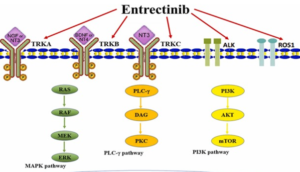
Chemotherapy works broadly.
Entrectinib is designed for a specific biological target.
That difference matters.
Patients often experience:
• more rapid tumour shrinkage
• better day-to-day quality of life
• effective control of brain metastases (due to the drug’s ability to cross the blood-brain barrier)
Tolerability:
While generally better tolerated than chemotherapy, patients may experience specific side effects like taste changes (dysgeusia), fatigue, dizziness, or weight gain. Managing these early is key to staying on treatment.
What happens over time?
Like all targeted therapies, resistance can develop.
But importantly:
• many patients experience meaningful periods of control
• newer treatments and clinical trials continue to expand options
• decisions are made step-by-step as the disease evolves
This fits into a broader pathway:
→ When lung cancer grows after targeted therapy: how we decide what to do next
Why second opinions matter in this space
For patients coming from Sri Lanka, the Maldives, Indonesia, and the Philippines, the issue is often not access to treatment —
it is access to the right sequence of decisions.
The most common gaps I see:
• molecular testing not done upfront
• results not fully interpreted (missing the ROS1 fusion)
• targeted therapy delayed unnecessarily
If you are unsure whether this testing has been done — or whether the result has been fully interpreted — this is exactly where a second opinion can be helpful.
In many of these situations, a second opinion does not change everything
it simply realigns the pathway early, when it matters most.
The bigger picture
ROS1-positive lung cancer is one of the clearest examples of how cancer treatment has changed.
Two patients may have identical scans.
But one receives chemotherapy.
The other receives a targeted tablet that controls the cancer for years.
That difference comes down to one step:
Understanding the biology before choosing the treatment.
Key Takeaway
• ROS1-positive lung cancer can be treated with highly effective targeted therapy when identified early.
• Entrectinib offers strong response rates, including in brain metastases, with some patients achieving much longer control than average.
• The most important step is ensuring the right molecular test (Next-Generation Sequencing or FISH) is done before treatment begins.
Final note
This article is part of a broader series written from a clinical practice in Melbourne, Australia, where treatment decisions are increasingly guided by tumour biology rather than location.
Many patients now seek second opinions across borders — particularly from Sri Lanka, the Maldives, Indonesia, and the Philippines — not because treatment is unavailable locally, but because the sequence and interpretation of decisions can change outcomes.
Q&A: Understanding your Diagnosis
Q: I’ve already started chemotherapy. Is it too late to test for ROS1?
A: No. While it is ideal to test before starting, molecular testing can—and should—be done at any point. If a ROS1 fusion is found, your treatment plan can be adjusted to include targeted therapy.
Q: My doctor mentioned “Brain Metastases.” How does Entrectinib help?
A: Many older lung cancer drugs have trouble entering the brain. Entrectinib was specifically engineered to cross the blood-brain barrier. In clinical trials, it showed a high “intracranial response rate,” meaning it is effective at shrinking tumours that have spread to the brain.
Q: Is Entrectinib a “forever” treatment?
A: It is a daily tablet taken for as long as the cancer remains stable and the side effects are manageable. While resistance can eventually develop, some patients remain on the drug for years—this is the “tail of the curve” mentioned earlier.
Q: What are the main side effects I should watch for?
A: Unlike chemotherapy, which causes hair loss and severe nausea, Entrectinib’s common side effects include taste changes (dysgeusia), fatigue, dizziness, or mild swelling (oedema). Most are manageable with dose adjustments.
Key Evidence
• Drilon A, Siena S, Dziadziuszko R, et al. Entrectinib in ROS1 fusion–positive non–small-cell lung cancer: integrated analysis of three phase 1–2 trials. Lancet Oncol. 2020;21(2):261-270.
• Dziadziuszko R, Krebs MG, De Braud F, et al. Updated integrated analysis of entrectinib in ROS1 fusion-positive non-small-cell lung cancer. J Clin Oncol. 2021;39(11):1253-1263.
• National Comprehensive Cancer Network (NCCN). Non–Small Cell Lung Cancer Guidelines. V3.2024.