
For women considering breast screening, the right imaging test depends on much more than simply choosing between mammography, ultrasound and MRI.
Who is this article for?
This article is for women who:
- have been told they have dense breasts;
- have a family history of breast or ovarian cancer;
- have recently undergone genetic testing;
- know they carry a hereditary breast cancer gene variant; or
- simply want to know whether mammography, ultrasound or breast MRI is the right test for them.
One of the most common questions I hear in the clinic is:
Should I have a mammogram, an ultrasound or a breast MRI?
The answer is not the same for every woman.
The best breast scan is not necessarily the most advanced scan. It is the right scan for your personal level of breast cancer risk.
The short answer
- Mammography remains the main screening test for many women.
- Ultrasound is particularly useful for investigating a lump or another abnormal area, but is not usually a complete screening strategy on its own.
- Breast MRI is more sensitive than mammography and is particularly important for some women at high inherited or calculated risk.
- Genetic testing can change when screening begins, how often it occurs and which scan is used.
- The most important step is to understand the woman’s overall risk first, and then choose the appropriate screening test.
That final point is the one that surprised me most.
My clinical observation
Every week, I meet women who believe they simply need “a breast scan.”
Some have been having annual ultrasounds for many years.
Others believe that MRI must always be the best test because it is the newest or most advanced.
Some have been told they have dense breasts and are understandably worried that a mammogram may not be enough.
But breast screening should not begin by choosing a scan.
It should begin by understanding the woman’s individual risk.
For one woman, a routine mammogram may be exactly the right test.
For another woman, genetic testing may reveal that routine mammography alone is not enough and that breast MRI should become an important part of her surveillance.
That is the central lesson of this article:
Understand the risk first. Then choose the scan.
What surprised me from our Australian research
Many people assume hereditary breast cancer is usually obvious.
They imagine several women in the same family developing breast or ovarian cancer across multiple generations.
Sometimes that pattern is present.
But our Australian research showed that inherited cancer risk can be much less obvious.
In the MAGIC study, clinically important inherited cancer variants were identified in 31 of 474 women with newly diagnosed breast cancer—about 6 or 7 women in every 100 tested.
Among the women found to carry a pathogenic variant, around 4 in 10 had either no reported family history of breast cancer or their family history was unknown.
That matters because families can be small. A woman may have few female relatives. Cancer risk can be inherited through her father as well as her mother. Some diagnoses may never have been discussed openly.
A reassuring-looking family history does not always exclude inherited cancer risk.
Which breast scan is right for you?
| Breast investigation | What is it mainly used for? | What should patients remember? |
| Mammogram | The main breast-screening test for many women | An excellent screening test, although some cancers can be harder to see in very dense breast tissue |
| Breast ultrasound | Investigating a lump or another specific area of concern, and sometimes providing additional imaging in selected women | Usually an additional test rather than a complete screening strategy by itself |
| 3D mammogram | Producing multiple thin images through the breast | May reduce the problem of overlapping breast tissue and make some abnormalities easier to see |
| Contrast-enhanced mammogram | Using mammography and contrast to highlight suspicious areas | Can be useful for selected women when MRI is unavailable or unsuitable |
| Breast MRI | A very sensitive screening test that is particularly valuable for selected women at high inherited or calculated risk | Particularly valuable for selected women at high inherited or calculated risk, but not needed by everyone |
| Genetic testing | An inherited gene change that increases cancer risk may mean screening should start earlier, happen more often, or include breast MRI. | A pathogenic variant may lead to earlier, more frequent or different screening, often including breast MRI |
The most important row is the final one.
Genetic testing does not simply provide information.
It can change the breast-screening test a woman should receive.
Mammography: the main breast screening test for many women
A mammogram is a low-dose X-ray examination of the breast.
It remains the foundation of breast cancer screening for many women and can identify cancers before they cause symptoms.
For many women at average population risk, routine mammographic screening remains an appropriate starting point.
Mammograms become more difficult to interpret when the breasts are very dense because dense breast tissue and many breast cancers both appear white on the image.
A helpful analogy is trying to see a snowball against a white background.
The cancer may still be visible, but it can be more difficult to recognise.
However, dense breasts do not automatically mean that every woman needs MRI.
Breast density is one part of the overall risk assessment.
Do dense breasts mean I need an MRI?
Not necessarily.
Dense breast tissue can make cancer more difficult to see on a mammogram, and breast density is also one factor that can increase breast cancer risk.
However, breast density should not be considered in isolation.
I would usually look at the whole picture—including age, family history, previous breast biopsies, genetic information and estimated breast cancer risk—before deciding whether additional imaging such as MRI is appropriate.
Dense breasts are a reason to assess risk, not an automatic reason for every woman to have MRI.
Key message
Mammography remains an excellent screening test, but it may not be the complete answer for every woman.
What is a 3D mammogram?
A 3D mammogram is also called breast tomosynthesis.
Instead of producing only a small number of flat images, the machine takes multiple images from slightly different angles.
These are reconstructed into thin sections through the breast.
A simple way to understand the difference is:
A standard mammogram is like looking at a closed book.
A 3D mammogram allows the radiologist to look through the book one page at a time.
Tomosynthesis can reduce the problem of overlapping breast tissue and may improve detection in some women, including women with dense breasts.
However, 3D mammography is still a mammographic test.
It does not replace MRI when a woman’s inherited risk is sufficiently high to require MRI surveillance.
Breast ultrasound: useful, but usually not a replacement
Ultrasound uses sound waves rather than radiation.
It is particularly useful when investigating a breast lump or examining an area already identified on a mammogram or clinical examination.
It can help determine whether a lump is solid or fluid-filled and is commonly used to guide breast biopsies.
However, many women believe that having an annual ultrasound means they have completed comprehensive breast cancer screening.
That is usually not correct.
Ultrasound is particularly useful for investigating a lump or another breast abnormality. In selected women it may also be used as additional screening, but it is not usually a complete screening strategy on its own.
It is not normally a complete replacement for mammography or high-risk MRI surveillance.
Clinical pearl
Ultrasound is excellent at examining a specific abnormality. In selected situations it can provide useful additional screening information, but it should not automatically be treated as a complete screening program by itself.
Breast MRI: A very sensitive test for woman at higher risk
Breast MRI uses a magnetic field rather than X-rays.
During most screening breast MRI examinations, contrast is injected into a vein. The scan then identifies areas within the breast that take up contrast in a potentially abnormal pattern.
Breast MRI is one of our most sensitive tools for detecting breast cancer.
This makes it extremely valuable for women with a high inherited risk, including many women who carry mutations in genes such as BRCA1, BRCA2 or PALB2.
These women can develop breast cancer at a younger age, when their breast tissue is often dense and mammography may be less sensitive.
MRI may therefore identify a cancer that is not obvious on a mammogram.
However, MRI is not automatically the right test for every woman.
Because it is so sensitive, MRI can also identify areas that appear abnormal but are ultimately found not to be cancer. This can lead to additional scans or biopsies.
The correct message is not:
“MRI is the best breast scan.”
The correct message is:
Breast MRI can be an extremely important screening test for the right higher-risk woman.
How genetic testing can lead to a better screening test
This is the most important teaching point.
Imagine a woman in her thirties with no obvious family history of breast cancer.
Without any additional information, she may appear to have a relatively reassuring family history.
But genetic testing may reveal that she carries a high-risk hereditary breast cancer mutation.
That result changes the clinical picture.
She may no longer be someone who simply waits until routine population mammographic screening begins.
She may need earlier surveillance.
Most importantly, she may need a more sensitive screening test—often breast MRI.
In other words:
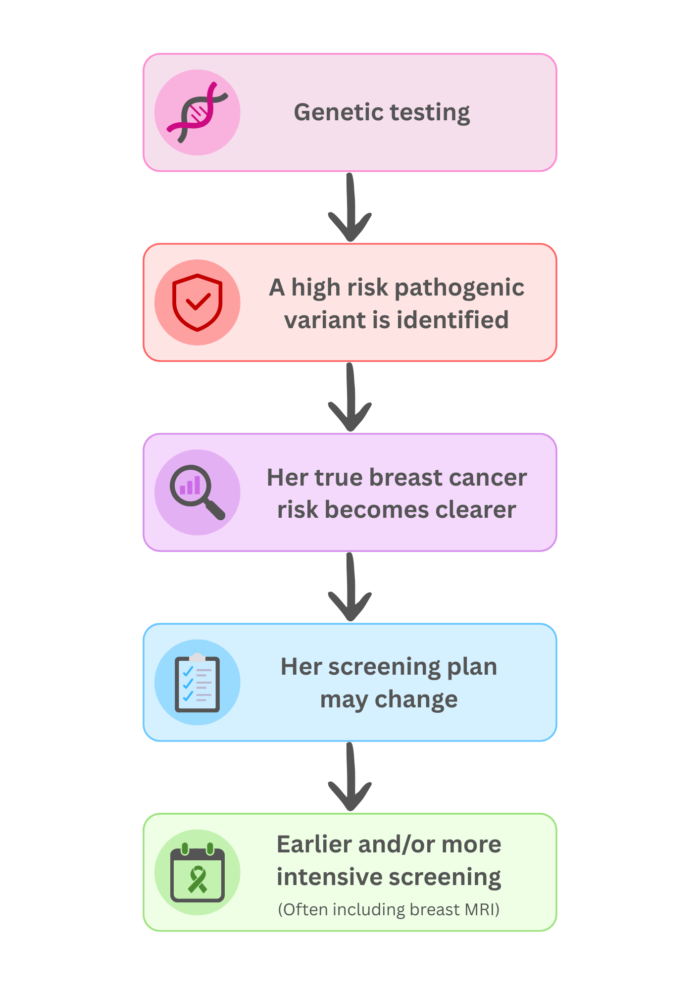
This is why genetic testing is not simply about labelling someone as “positive” or “negative.”
It can directly change how we try to detect cancer early.
A genetic result can change the scan.
For some women, that change may mean moving from routine mammography to a high-risk surveillance program that includes MRI.
What about contrast-enhanced mammography?
Contrast-enhanced mammography combines a mammogram with an iodine-based contrast injection.
The contrast highlights areas with increased blood supply, which can make some cancers more visible.
Contrast-enhanced mammography may be considered in selected women when breast MRI is unavailable, cannot be tolerated or is otherwise unsuitable.
A simple way to think about it is:
Contrast-enhanced mammography combines mammographic images with some of the contrast information we usually associate with MRI.
It is a valuable option in selected circumstances, but it is not automatically needed by every woman with dense breasts or every woman seeking more intensive screening.
How do we decide which screening test a woman needs?
In the Family Cancer Clinic, we do not begin by ordering the most advanced scan.
We begin by asking a more important question:
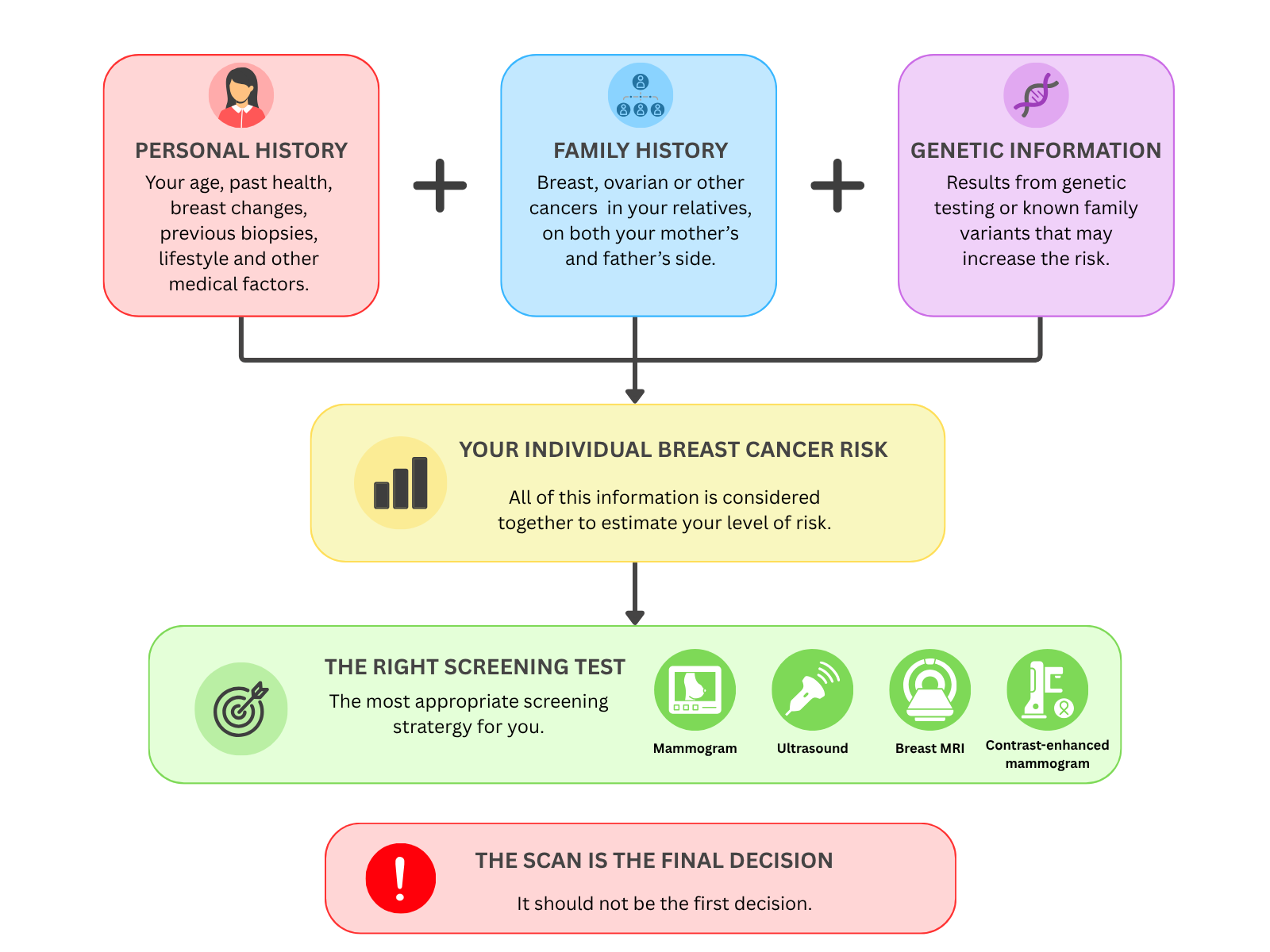
What is this woman’s actual risk of developing breast cancer?
We consider her personal history, family history and any genetic test results.
We may also use validated risk-assessment tools to estimate her future breast cancer risk.
Patients do not need to understand every mathematical calculation.
The process can be summarised very simply:
What does this mean for women in Australia?
In Australia, routine breast screening and high-risk surveillance are not the same thing.
For many women at average population risk, mammography through BreastScreen remains the main screening approach.
Women at higher inherited or estimated breast cancer risk may need a different screening plan, which can include breast MRI.
Importantly, Medicare funding for high-risk breast MRI changed from 1 July 2026. Eligible asymptomatic women younger than 60 may now qualify for Medicare-subsidised breast MRI under MBS item 63464, depending on their genetic or calculated level of breast cancer risk.
Genetic testing may also be Medicare funded in defined circumstances.
This is why I think the correct question is not simply:
“Can I get an MRI?”
It is:
“What is my breast cancer risk, and what surveillance program is appropriate for me?”
Does every woman need genetic testing?
No.
Genetic testing is most useful when a woman’s personal or family circumstances suggest that an inherited cancer risk may be present.
However, the criteria are broader than many people realise.
A woman may be offered genetic testing because of her own breast cancer diagnosis, her age at diagnosis, the characteristics of her cancer or her wider family history.
The most important point is that the absence of a dramatic family history does not automatically exclude genetic risk.
Our research demonstrated exactly that.
In our Australian research, around 4 in 10 women found to carry a pathogenic inherited cancer variant had either no reported family history of breast cancer or their family history was unknown.
What does a positive genetic result change?
A positive result in a high-risk breast cancer gene may change:
- when breast screening begins;
- which screening test is used;
- whether breast MRI is added;
- how frequently surveillance occurs;
- whether cancer-prevention medication or surgery should be discussed; and
- whether close relatives should be offered testing.
But for this article, the central point is the simplest one:
Genetic testing may reveal that a woman needs earlier, more frequent or more sensitive breast surveillance.
Which breast scan might I need?
For many women at average risk
Routine mammography may be the correct screening strategy.
For a woman with a breast lump
Ultrasound may be used with mammography to examine the specific abnormality.
For a woman with very dense breasts
Her overall risk should be assessed rather than automatically assuming she needs MRI.
For a woman with a high-risk pathogenic genetic variant
Earlier and more sensitive surveillance, often including breast MRI, may be recommended.
When MRI cannot be performed
Contrast-enhanced mammography may be considered in selected situations.
The one message I want every woman to remember
The best breast scan is not the newest or most expensive scan.
It is the right scan for your personal level of risk.
For many women, that will be mammography.
If there is a particular breast abnormality, ultrasound may provide the additional information needed.
When genetic testing identifies a high inherited risk, breast MRI may become one of the most important parts of surveillance.
The purpose of genetic assessment is not simply to give someone a result.
It is to use that information to provide better cancer prevention and better screening.
Key takeaways
- Mammography remains the main screening test for many women.
- Dense breasts do not automatically mean you need MRI; your overall risk matters.
- Ultrasound is usually an additional test rather than a complete screening strategy on its own.
- Breast MRI is particularly valuable for selected women at high inherited or estimated breast cancer risk.
- Genetic testing can change when screening starts, how often it occurs and which breast imaging tests are appropriate.
Understand the risk first.
Then choose the scan.
Key evidence
- De Silva DL, Stafford L, Skandarajah AR, et al. Universal genetic testing for women with newly diagnosed breast cancer in the context of multidisciplinary team care. Med J Aust. 2023;218(8):368-373. doi:10.5694/mja2.51906
- eviQ. Breast cancer (high risk with no family history of ovarian cancer) – risk management (female). Version 8. Updated March 6, 2026. Accessed August 10, 2026. https://www.eviq.org.au/cancer-genetics/adult/risk-management/743-breast-cancer-high-risk-with-no-family-histor
- Cancer Council Australia. Breast cancer screening. Accessed August 10, 2026. https://www.cancer.org.au/about-us/policy-and-advocacy/early-detection/breast-cancer/screening
- Cancer Council Australia. Breast cancer symptoms, risks and screening. Updated July 2, 2026. Accessed August 10, 2026. https://www.cancer.org.au/types-of-cancer/breast-cancer/symptoms-risks-and-screening
- Australian Government Department of Health, Disability and Ageing. Medicare Benefits Schedule Item 63464: magnetic resonance imaging of both breasts for specified high-risk patients. Updated July 1, 2026. Accessed August 10, 2026. https://www9.health.gov.au/mbs/fullDisplay.cfm?q=63464&type=item
- Cancer Council Australia. Roadmap for Optimising Screening in Australia – Breast. Accessed August 10, 2026. https://www.cancer.org.au/about-us/policy-and-advocacy/early-detection/breast-cancer/rosa
Frequently asked questions (FAQs)
Is breast MRI better than a mammogram?
MRI is more sensitive, but that does not mean every woman should have one. Mammography remains the main screening test for many women, while MRI is particularly valuable for selected women at higher inherited or calculated risk.
Do dense breasts mean I need an MRI?
Not automatically. Dense breasts can make mammograms harder to interpret and can also increase breast cancer risk, but the decision about MRI should consider your overall risk.
Can ultrasound replace a mammogram?
Usually not as a complete screening strategy. Ultrasound is particularly useful for investigating a lump or another abnormal area and may be added to screening in selected situations.
What is a 3D mammogram?
A 3D mammogram, or breast tomosynthesis, takes multiple images through the breast and reconstructs them into thin sections. This can reduce the problem of overlapping breast tissue.
Can I carry a breast cancer gene variant without a family history?
In our Australian research, around 4 in 10 women found to carry a pathogenic inherited cancer variant had either no reported family history of breast cancer or their family history was unknown.
How can genetic testing change breast screening?
A high-risk genetic result can change when screening begins, how often it occurs and which imaging tests are used. For some women, this includes regular breast MRI.
Is high-risk breast MRI covered by Medicare in Australia?
For eligible women, yes. Current Medicare criteria include specified high-risk asymptomatic women younger than 60, depending on their genetic or estimated breast cancer risk.
What should I do if I find a breast lump?
Do not wait for your next routine screening mammogram. A new breast change should be assessed by a doctor and may require diagnostic imaging rather than routine screening.
Dr Dilanka De Silva
MBBS, MRCP(UK), MRCP(UK SCE Oncology), FRACP, PhD
Medical Oncologist & Cancer Genetics Physician
Memorial Sloan Kettering Cancer Center Fellow (New York, USA)