
Who this is for
This article is for patients diagnosed with T1 bladder cancer in Melbourne or seeking an international second opinion about high-grade T1 disease. You may have been told that the cancer has a significant chance of returning and are worried that recurrence automatically means progression into the bladder muscle.
Perhaps you have gone home, searched online and found frightening statistics. You may have been left believing that your bladder cancer will inevitably grow into the bladder muscle, spread to other parts of your body or eventually become life-threatening.
If that is how you are feeling, I completely understand.
The good news is that the full story is more encouraging—and more individual—than many websites suggest.
The one big message
Bladder cancer coming back is not the same as bladder cancer progressing.
T1 bladder cancer must be taken seriously and followed carefully. However, many recurrences remain non-muscle-invasive, meaning they have not grown into the bladder muscle and may still be treated with bladder-preserving approaches.
The risk is not the same for every patient. It depends on features such as the grade of the cancer, whether carcinoma in situ is present, the size and number of tumours, the findings from a repeat operation and how the cancer responds to BCG treatment.
Clinical observation
Last week, I saw three different patients with bladder cancer in my clinic.
Their ages, symptoms and stories were all different.
Yet they all had one thing in common.
Every one of them either still smoked or had smoked for many years in the past.
That reminded me how few people realise that bladder cancer is one of the cancers most strongly linked to smoking.
Most people know that smoking causes lung cancer.
Far fewer realise that smoking is also the most important preventable risk factor for bladder cancer and is linked to approximately half of bladder cancer cases.
During my fellowship training at Memorial Sloan Kettering Cancer Center in New York, I saw how careful bladder-preserving treatment and close surveillance could achieve very good long-term outcomes in appropriately selected patients.
Seeing these recent patients reminded me how much fear people carry after reading older or poorly explained statistics online.
What surprised me
What surprised me was not that bladder cancer can come back.
We have known that for decades.
What surprised me was how many patients believed that if the cancer returned, it automatically meant that it had grown into the bladder muscle or spread throughout the body.
That is not correct.
One of the biggest misunderstandings is confusing recurrence with progression.
What does recurrence mean?
Recurrence means that the cancer has returned after treatment.
Many recurrences remain confined to the inner layers of the bladder. These are still called non-muscle-invasive recurrences.
The appropriate treatment depends on whether the recurrence is low grade or high grade, how soon it appeared, how many tumours are present and which treatments the patient has already received.
What does progression mean?
Progression means that the cancer has become more aggressive or has grown deeper into the bladder muscle or beyond.
This is more serious than recurrence alone.
The distinction is incredibly important.
High-grade T1 bladder cancer can have a substantial risk of recurrence, and in some groups the long-term recurrence risk may exceed 50%.
However, recurrence does not automatically mean progression to muscle-invasive disease.
That is one of the most important messages I want every patient to understand.
| Term | What it means | Why it matters |
| Recurrence | The bladder cancer has returned after treatment | It may still be confined to the inner layers of the bladder and may remain treatable with bladder-preserving approaches |
| Progression | The cancer has grown deeper, particularly into the bladder muscle or beyond | This usually requires a different and more intensive treatment approach |
| Non-muscle-invasive recurrence | The cancer has returned but has not reached the bladder muscle | Treatment depends on the grade, timing, number of tumours and previous BCG treatment |
| Muscle-invasive progression | The cancer has grown into the muscle layer of the bladder | Surgery, chemotherapy, immunotherapy or radiotherapy may need to be considered |
Understanding bladder cancer
Bladder cancer is commonly divided into three broad groups.
Non-Muscle-Invasive Bladder Cancer
Most bladder cancers—approximately three-quarters—are diagnosed before they have reached the bladder muscle.
This group includes:
- Ta bladder cancer: the cancer is limited to the inner lining of the bladder.
- T1 bladder cancer: the cancer has grown into the supporting tissue beneath the bladder lining but has not reached the bladder muscle.
- Carcinoma in situ, or CIS: a flat, high-grade cancer that remains on the bladder lining but can behave aggressively.
The words non-muscle-invasive do not mean that every cancer in this group is low risk.
For example, high-grade T1 cancer and carcinoma in situ can have a meaningful risk of recurrence and progression and require careful treatment.
Muscle-Invasive Bladder Cancer
This means that the cancer has grown into the thick muscle layer of the bladder wall.
It usually requires a different treatment approach, which may include surgery to remove the bladder, chemotherapy, immunotherapy or radiotherapy in selected patients.
Metastatic Bladder Cancer
This means that the cancer has spread beyond the bladder to other parts of the body, such as lymph nodes, bones, lungs or liver.
Only a minority of patients have metastatic disease when first diagnosed.
T1 does not tell us the whole story
The label T1 tells us how deeply the cancer has grown, but it does not tell us everything about its future behaviour.
A single, small T1 tumour may behave differently from a large tumour, several tumours appearing at the same time, or a high-grade tumour that has returned.
Important features include:
- The grade of the tumour, particularly whether it is high grade
- Whether carcinoma in situ is also present
- The number and size of tumours
- Whether the tumour has returned previously
- Whether cancer remains at the repeat TURBT
- Whether unusual or aggressive cell patterns are present
- Whether cancer cells are seen in blood vessels or lymphatic channels
This is why the pathology report and the findings from a repeat operation are so important.
How is T1 bladder cancer treated?
The aim is to stop the cancer before it reaches the bladder muscle while preserving the bladder safely whenever possible.
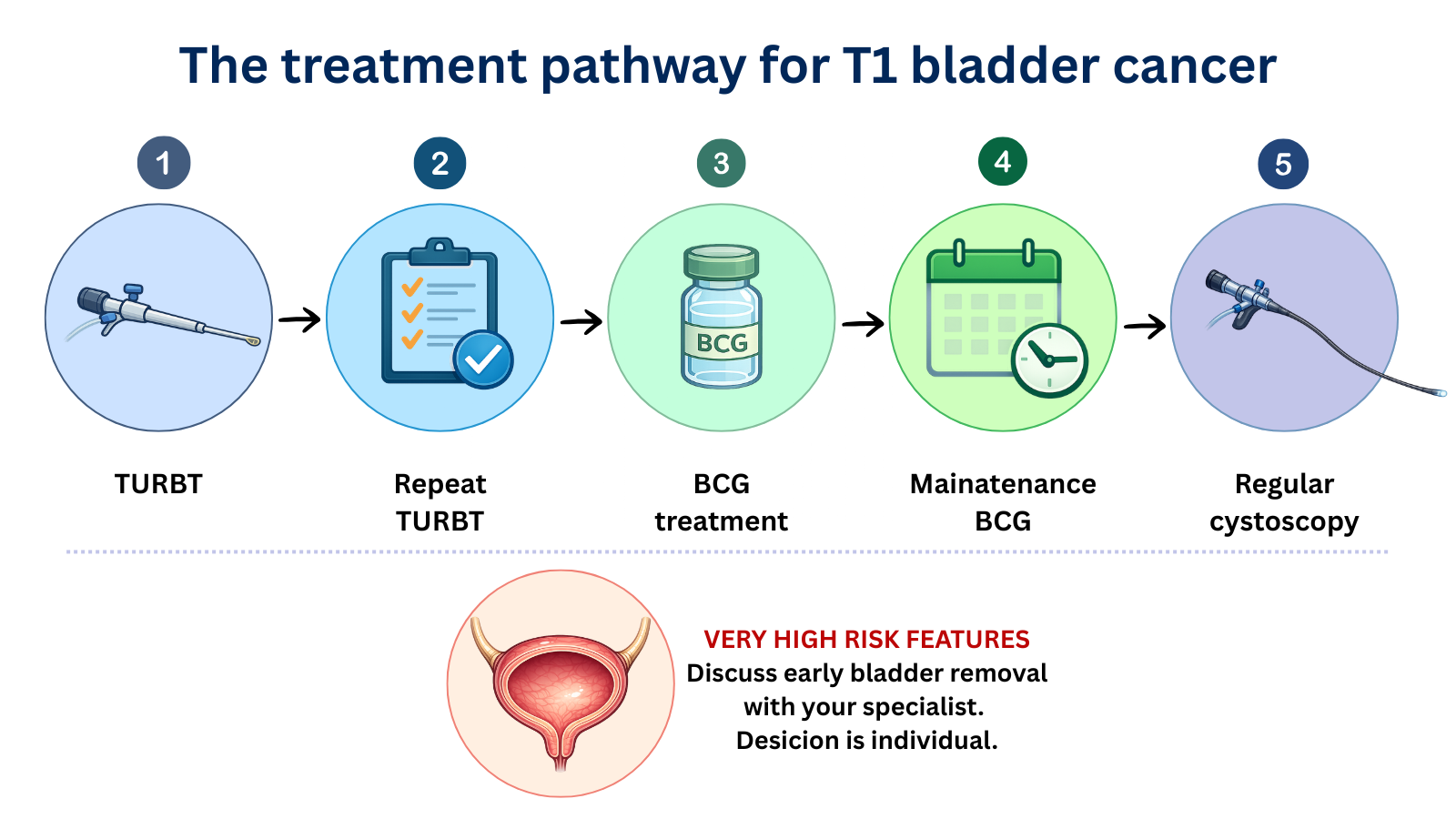
Step 1: Initial TURBT
The visible tumour is removed from inside the bladder using a telescope passed through the urethra.
This procedure is called a transurethral resection of bladder tumour, or TURBT.
The tissue is then examined under a microscope to determine the type, grade and depth of the cancer.
Step 2: Repeat TURBT
For T1 bladder cancer, a second TURBT is usually recommended within several weeks.
This is not necessarily because the first operation was unsuccessful.
The repeat procedure helps to:
- Check whether any cancer remains
- Confirm that the cancer has not reached the bladder muscle
- Make sure enough bladder muscle was sampled
- Identify patients who may need more intensive treatment
Current guidelines recommend repeat resection for T1 disease because accurate staging is essential before choosing bladder-preserving treatment.
Step 3: BCG Treatment
Many patients with high-risk non-muscle-invasive bladder cancer receive BCG.
BCG stands for bacillus Calmette-Guérin. It is a weakened bacterium that stimulates the immune system inside the bladder.
The treatment is placed directly into the bladder through a small catheter, usually once a week for six weeks.
Because BCG is placed directly into the bladder, it is different from treatments given through a vein and usually has fewer effects throughout the whole body.
Step 4: Maintenance BCG
If BCG is working and remains tolerable, additional maintenance treatment is often given.
This may continue for one to three years, depending on:
- The patient’s risk group
- Side effects
- BCG availability
- Local hospital protocols
- The patient’s response to treatment
BCG following TURBT has been shown to reduce recurrence, and maintenance treatment is generally recommended for high-risk disease when feasible.
Step 5: Regular Surveillance
Patients need regular examinations of the bladder using a small camera. This is called a cystoscopy.
Urine tests and imaging of the kidneys and ureters may also be required.
These checks do not prevent the cancer from returning. Their purpose is to detect recurrence or progression as early as possible, when more treatment options may be available.
When might bladder removal be discussed?
BCG and surveillance are appropriate for many patients.
However, bladder-preserving treatment is not the safest option for everyone.
Removal of the bladder, called a radical cystectomy, may need to be discussed when there are very-high-risk features, such as:
- T1 cancer remaining at the repeat TURBT
- Associated carcinoma in situ
- Certain aggressive or unusual tumour types
- Cancer cells within lymphatic or blood vessels
- Repeated high-grade recurrence
- Cancer that does not respond adequately to BCG
This does not mean that every patient with T1 bladder cancer requires bladder removal.
It means that the risk of progression must be balanced against the potential benefits and life-changing consequences of major surgery.
The decision should be individualised and discussed carefully with an experienced urologist and oncology team.
What do the numbers really mean?
This is where patients can easily become frightened or misled.
The risk of recurrence and progression varies greatly between different groups of patients.
In one large Memorial Sloan Kettering series, 816 patients had no visible cancer detected after their first course of BCG. Doctors call this a complete response.
Among these selected patients:
- About 73 out of every 100 had not had the cancer return by two years
- About 46 out of every 100 had not had the cancer return by five years
- About 89 out of every 100 had not progressed into a more advanced stage by five years
This shows that recurrence was still common, but progression was much less common.
These results do not apply equally to every patient with T1 bladder cancer. They came from patients who had already responded to BCG at a specialist centre.
In another large analysis of patients treated with maintenance BCG, some high-risk T1 grade 3 patients had an estimated progression risk of approximately:
- 11 in every 100 at one year
- 20 in every 100 at five years
This shows why one percentage cannot describe every person with T1 bladder cancer.
The key message is not that progression risk is always low.
The key message is that recurrence is more common than progression and that the individual risk depends on the cancer’s features and response to treatment.
Things have changed dramatically
Another reason I wanted to write this article is that bladder cancer treatment has changed enormously.
Many people with appropriately treated T1 bladder cancer will not go on to develop advanced disease.
However, it is still reassuring to know that treatment has improved for patients whose cancer becomes muscle-invasive or spreads elsewhere.
In the EV-302 trial, patients with previously untreated locally advanced or metastatic urothelial cancer received either:
- Enfortumab vedotin combined with pembrolizumab, or
- Standard platinum-based chemotherapy
The median overall survival was:
- 31.5 months with enfortumab vedotin and pembrolizumab
- 16.1 months with chemotherapy
The median is the midpoint of the study group. This means that half the patients lived longer than these times and half lived for a shorter time.
These figures cannot predict exactly what will happen to an individual patient. They do show that modern treatment has substantially improved outcomes for some patients with advanced bladder cancer.
This is why I encourage patients to be cautious when reading older survival figures online. Some were calculated before today’s treatments were available.
What I tell my own patients
What I tell my own patients in the consulting room is this:
Do not panic after reading one frightening statistic online.
The first thing you need to understand is exactly what type and stage of bladder cancer you have.
If you have T1 bladder cancer, the cancer has not yet reached the bladder muscle.
However, we must still understand whether it is low risk, high risk or very high risk.
Everything we do—complete tumour removal, repeat TURBT, BCG treatment and careful surveillance—is designed to prevent the cancer from reaching the bladder muscle and to identify any change as early as possible.
Stay committed to treatment.
Keep attending follow-up appointments.
Ask what your pathology means and whether a repeat TURBT is needed.
Those regular bladder checks allow us to identify recurrence or progression as early as possible.
What this means for you
A diagnosis of T1 bladder cancer should be taken seriously, but it should not automatically remove hope.
Recurrence does not always mean progression.
The most important next steps are to:
- Confirm the pathology
- Make sure adequate bladder muscle was sampled
- Complete an appropriate repeat TURBT
- Understand your individual risk group
- Discuss whether BCG is suitable
- Understand when bladder removal may need to be considered
- Attend regular surveillance
The aim is not simply to remove the tumour that is visible today.
The aim is to prevent the cancer from reaching the bladder muscle while preserving the bladder safely whenever possible.
Key takeaways
- Recurrence and progression are different.
A bladder tumour can return while still remaining non-muscle-invasive. - T1 bladder cancer requires accurate staging.
A repeat TURBT and careful pathology review can materially change the treatment plan. - Treatment must match the individual risk.
BCG and surveillance are appropriate for many patients, while very-high-risk features may justify discussing early bladder removal.
Key evidence
- Gontero P, Mariappan P, Pradere B, et al. EAU guidelines on non–muscle-invasive bladder cancer (Ta, T1, and CIS): a summary of the 2026 guidelines update. Eur Urol. Published online 2026. doi:10.1016/j.eururo.2026.04.009
- Holzbeierlein JM, Bixler BR, Buckley DI, et al. Diagnosis and treatment of non–muscle-invasive bladder cancer: AUA/SUO guideline: 2024 amendment. J Urol. 2024;211(4):533-538. doi:10.1097/JU.0000000000003846
- Herr HW, Schwalb DM, Zhang ZF, et al. Intravesical bacillus Calmette-Guérin therapy prevents tumor progression and death from superficial bladder cancer: ten-year follow-up of a prospective randomized trial. J Clin Oncol. 1995;13(6):1404-1408. doi:10.1200/JCO.1995.13.6.1404
- Herr HW, Dalbagni G, Donat SM. Bacillus Calmette-Guérin without maintenance therapy for high-risk non–muscle-invasive bladder cancer. Eur Urol. 2011;60(1):32-36. doi:10.1016/j.eururo.2011.03.051
- Cambier S, Sylvester RJ, Collette L, et al. EORTC nomograms and risk groups for predicting recurrence, progression, and disease-specific and overall survival in non–muscle-invasive stage Ta-T1 urothelial bladder cancer patients treated with 1-3 years of maintenance bacillus Calmette-Guérin. Eur Urol. 2016;69(1):60-69. doi:10.1016/j.eururo.2015.06.045
- Mori K, Mostafaei H, Abufaraj M, Yang L, Egawa S, Shariat SF. Smoking and bladder cancer: review of the recent literature. Curr Opin Urol. 2020;30(5):720-725. doi:10.1097/MOU.0000000000000804
- Powles T, Valderrama BP, Gupta S, et al. Enfortumab vedotin and pembrolizumab in untreated advanced urothelial cancer. N Engl J Med. 2024;390(10):875-888. doi:10.1056/NEJMoa231211
Frequently asked questions (FAQs)
Does smoking cause bladder cancer?
Yes.
Smoking is the biggest preventable risk factor for bladder cancer and is linked to approximately half of cases.
Cancer-causing chemicals from tobacco smoke enter the bloodstream, are filtered by the kidneys and collect in the urine. The bladder lining is then repeatedly exposed to these chemicals.
What does T1 bladder cancer mean?
T1 means the cancer has grown beneath the bladder lining into the supporting tissue but has not reached the bladder muscle.
It does not, by itself, tell us the full level of risk. The grade, size, number of tumours, associated carcinoma in situ and repeat TURBT findings are also important.
Why do I need a repeat TURBT?
A repeat TURBT checks whether any cancer remains and helps confirm that muscle-invasive disease was not missed.
This information can significantly affect the treatment plan.
Why do I need regular cystoscopies?
A cystoscopy uses a small camera to examine the inside of the bladder.
Bladder cancer has a tendency to return. Regular cystoscopies allow recurrence or progression to be found as early as possible.
Does every recurrence become muscle-invasive?
No.
Many recurrences remain non-muscle-invasive.
However, high-grade, early or repeated recurrences may require more intensive treatment.
Should I stop smoking after my diagnosis?
Yes.
Stopping smoking reduces further exposure to cancer-causing chemicals and provides major benefits for heart, lung and overall health.
It may also reduce the risk of future bladder cancer events, although an individual patient’s risk depends on several factors.
Does everyone with T1 bladder cancer need BCG?
No.
BCG is commonly recommended for high-risk non-muscle-invasive bladder cancer, but the best treatment depends on the pathology, repeat TURBT findings, other medical conditions and the patient’s preferences.
Does everyone with T1 bladder cancer need their bladder removed?
No.
Many patients can be treated with TURBT, BCG and careful surveillance.
However, early bladder removal may need to be discussed when the cancer has very-high-risk features or does not respond to BCG.
Dr Dilanka De Silva
MBBS, MRCP(UK), MRCP(UK SCE Oncology), FRACP, PhD
Medical Oncologist & Cancer Genetics Physician
Memorial Sloan Kettering Cancer Center Fellow (New York, USA)