
Who this is for
This article is for patients with metastatic prostate cancer after hormone tablets have stopped controlling the disease.
You may be hoping to avoid another course of chemotherapy and wondering whether changing to a different hormone tablet is a reasonable option.
Clinical observation
A gentleman in his early 60s recently sought my opinion regarding his metastatic prostate cancer.
Some details have been changed to protect his privacy.
His prostate cancer had already become metastatic castration-resistant prostate cancer, often shortened to mCRPC. This means that the cancer was continuing to grow despite treatment keeping his testosterone at a very low level.
He had extensive bone metastases and had previously received:
- Androgen-deprivation therapy to suppress testosterone
- A modern hormone tablet targeting the androgen-receptor pathway
- Docetaxel chemotherapy
- Radium-223 treatment for bone metastases
His question was very simple:
“Doctor, have I really run out of tablet options, or can I simply change to another hormone tablet and avoid chemotherapy?”
This is one of the most common questions I hear in clinic.
The one big message
Another hormone tablet may occasionally help.
However, once prostate cancer has become resistant to one modern hormone treatment, the benefit from another medicine targeting the same pathway is often modest and may not last for long.
What surprised me
Many patients understandably assume that if one hormone tablet stops working, another similar tablet should work just as well.
Unfortunately, prostate cancer biology is usually more complicated than that.
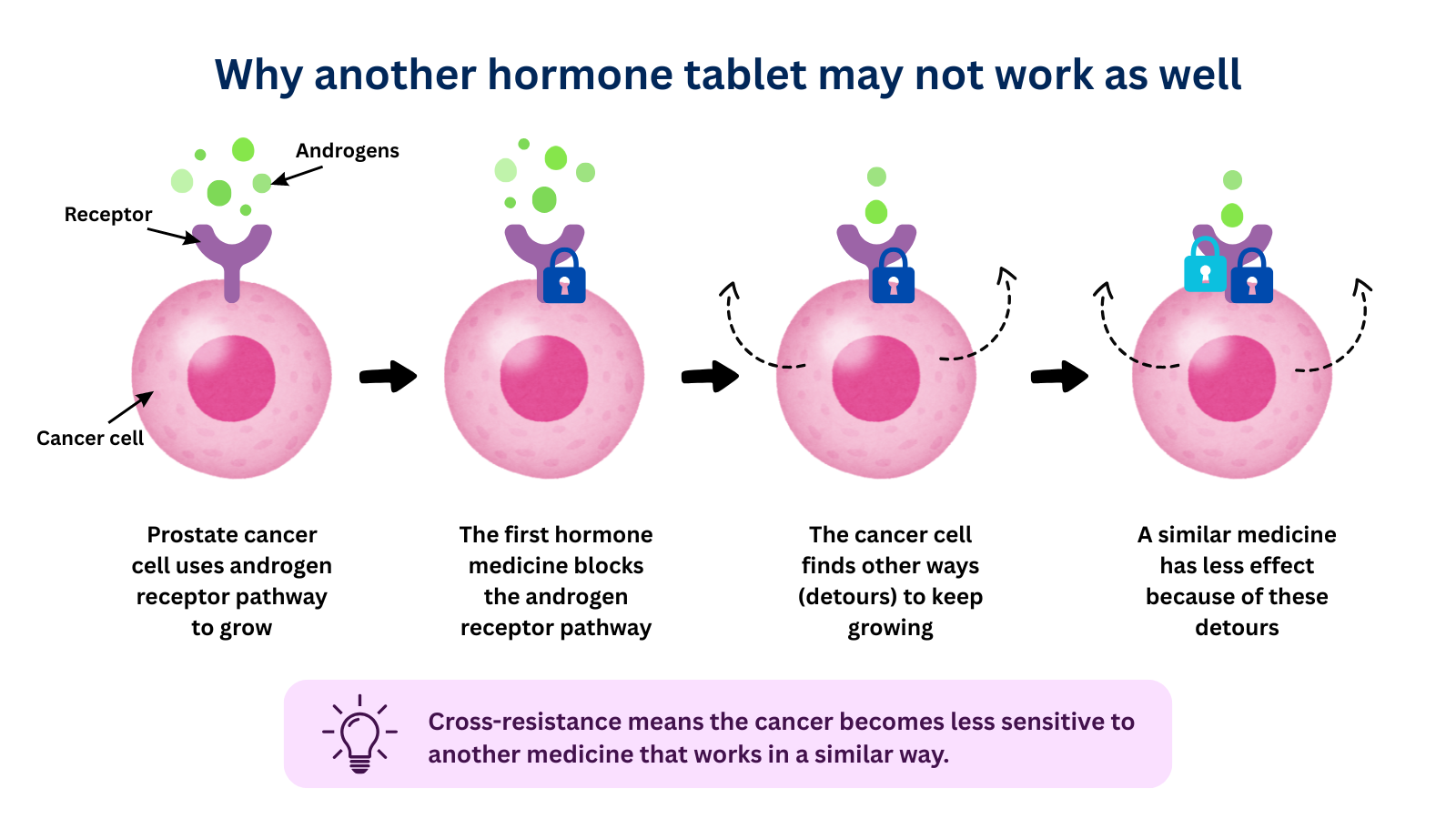
Once the cancer develops resistance to one modern androgen-receptor pathway inhibitor, it may also become less sensitive to other drugs targeting the same pathway. This is known as cross-resistance.
It does not mean that another hormone tablet will never work. It means that the chance of a substantial and lasting response is generally lower than it was with the first tablet.
Can I switch to another hormone tablet?
The answer is:
Sometimes—but it may not be the most effective option.
The best-studied medicines in this situation are:
- Abiraterone
- Enzalutamide
They work in different ways, but both target the androgen-receptor signalling pathway that prostate cancer cells use to grow.
One clinical trial looked at men who received abiraterone followed by enzalutamide, or the same treatments in the opposite order.
After changing treatment:
- Around 1 in 3 men had a PSA reduction of at least 30% when enzalutamide was given after abiraterone.
- Around 1 in 25 men had the same PSA reduction when abiraterone was given after enzalutamide.
This suggests that enzalutamide after abiraterone may still help some selected patients.
However, a fall in PSA does not always mean that the cancer will remain controlled for longer, symptoms will improve, or the treatment will help someone live longer.
Therefore, I would not recommend another hormone tablet simply because it is available as a tablet or appears easier than other treatments.
What are the options for metastatic prostate cancer after hormone tablets?
Before moving to another treatment, I believe every patient deserves a careful review of whether a more personalised option may be available.
| Options to consider | When it may be relevant | What patients should know |
| Genetic testing and PARP inhibitors | When testing identifies an eligible alteration, particularly BRCA1 or BRCA2 | The benefit depends on the exact genetic alteration and treatment eligibility |
| Lutetium-177 PSMA therapy | When the cancer is sufficiently PSMA-positive | A PSMA PET scan and other assessments are needed to determine suitability |
| Chemotherapy | When the cancer is progressing, causing symptoms or is unlikely to respond well to another hormone tablet | In some situations, chemotherapy may offer stronger evidence of cancer control |
| Clinical trial | When a suitable study is available | Trials may provide access to new targeted treatments or treatment combinations |
| Bone-protective treatment | When prostate cancer has spread to the bones | Denosumab or zoledronic acid may help reduce bone complications in suitable patients |
These options should be considered alongside how quickly the cancer is progressing, whether the patient has symptoms, previous treatments, blood counts, general health and the urgency of starting the next treatment.
Genetic testing and imaging are important, but they should not unnecessarily delay treatment when the cancer is progressing quickly or causing significant symptoms.
What about darolutamide or apalutamide?
Patients often ask whether these newer tablets may work after another hormone tablet has already failed.
Darolutamide and apalutamide are important prostate cancer treatments in particular clinical settings.
However, there is currently limited evidence to support routinely changing to darolutamide or apalutamide after metastatic castration-resistant prostate cancer has already progressed on another modern androgen-receptor pathway treatment.
They should not automatically be viewed as “unused tablets” that will work simply because the patient has not received them before.
The previous treatment, stage of disease and evidence supporting the proposed sequence all need to be considered.
What this means for you
Progression on one modern hormone tablet does not necessarily mean that you have run out of treatment options.
However, it does mean that simply moving to another similar tablet may not be the most effective next step.
The decision should take into account:
- Which hormone treatment you have already received
- How well and for how long it worked
- How quickly the cancer is progressing
- Your genetic testing results
- Whether the cancer is suitable for PSMA-targeted treatment
- Your previous chemotherapy
- Your symptoms and general health
- Your own priorities regarding treatment and quality of life
In some patients, another hormone tablet may still be reasonable, particularly when other treatments are unsuitable or the likely limitations have been clearly discussed.
In others, chemotherapy, PSMA-targeted treatment, a PARP inhibitor or a clinical trial may offer a better chance of meaningful cancer control.
My approach
When I see a patient in this situation, my priority is not simply to ask:
“Which tablet comes next?”
Instead, I ask:
“Has this patient had every appropriate assessment to identify a more personalised and potentially more effective treatment?”
I would review the pathology, previous treatment response, PSA pattern, scans, testosterone level, genetic results, PSMA findings, symptoms and general health.
Sometimes this review identifies a targeted treatment or a clinical trial.
Sometimes another hormone tablet remains a reasonable option.
In other situations, chemotherapy or PSMA-targeted treatment may have stronger evidence of benefit than changing from one hormone tablet to another.
The aim is not to avoid one particular type of treatment at all costs. It is to choose the option most likely to control the cancer while maintaining the best possible quality of life.
The Australian PBS position
In Australia, PBS funding generally does not support routine sequential use of modern androgen-receptor pathway medicines after the cancer has progressed.
The PBS generally subsidises one novel hormonal drug during a patient’s prostate cancer treatment, although exceptions may apply when the earlier medicine had to be permanently stopped because of severe intolerance.
PBS requirements can change and should be checked for the individual patient when treatment is being planned.
Key takeaways
- Switching from one modern hormone tablet to another may help some patients, but the benefit is often limited because prostate cancer can develop cross-resistance.
- Before choosing the next treatment, ask whether genetic testing, PSMA-targeted treatment, a PARP inhibitor or a clinical trial may be appropriate.
- The best treatment should be based on the biology and behaviour of the cancer—not simply on whether the treatment is a tablet or chemotherapy.
Key evidence
- Hatano K, Nonomura N. Systemic therapies for metastatic castration-resistant prostate cancer: an updated review. World J Mens Health. 2023;41(4):769-784. doi:10.5534/wjmh.220200
- Khalaf DJ, Annala M, Taavitsainen S, et al. Optimal sequencing of enzalutamide and abiraterone acetate plus prednisone in metastatic castration-resistant prostate cancer: a multicentre, randomised, open-label, phase 2 crossover trial. Lancet Oncol. 2019;20(12):1730-1739. doi:10.1016/S1470-2045(19)30688-6
- Taplin ME, Riaz IB, Rumble RB, et al. Systemic therapy in patients with metastatic castration-resistant prostate cancer: ASCO Living Guideline, version 2026.1. J Clin Oncol. 2026;44(6):e1-e14. doi:10.1200/JCO-25-02693
- Yu EY, Rumble RB, Agarwal N, et al. Germline and somatic genomic testing for metastatic prostate cancer: ASCO guideline. J Clin Oncol. 2025;43(6). doi:10.1200/JCO-24-02608
- Sartor O, de Bono J, Chi KN, et al. Lutetium-177–PSMA-617 for metastatic castration-resistant prostate cancer. N Engl J Med. 2021;385(12):1091-1103. doi:10.1056/NEJMoa2107322
- Atiq M, Chandran E, Karzai F, Madan RA, Aragon-Ching JB. Emerging treatment options for prostate cancer. Expert Rev Anticancer Ther. 2023;23(6):625-631. doi:10.1080/14737140.2023.2208352
Frequently asked questions (FAQs)
- Does This Mean Another Hormone Tablet Never Works?
No.
Some patients experience a temporary response, particularly when enzalutamide is given after abiraterone.
However, the average benefit is generally more modest than with the first hormone tablet, and a PSA fall does not necessarily mean that the treatment will improve survival.
- Can I Avoid Chemotherapy Completely?
Sometimes.
Depending on the cancer’s genetic results, PSMA findings, previous treatments and the patient’s overall health, targeted treatment, PSMA-directed therapy or a clinical trial may be appropriate.
However, avoiding chemotherapy should not be the only goal. For some patients, chemotherapy may have stronger evidence of controlling the cancer than another hormone tablet.
- Should Everyone Have Genetic Testing?
Most men with metastatic prostate cancer should be offered germline genetic testing.
Tumour testing should also be considered because the results may influence treatment choices.
Inherited genetic findings may also have implications for close family members.
- Does Australia Fund Changing From One Hormone Tablet to Another?
PBS funding is limited, and routine sequential use of modern androgen-receptor pathway medicines is generally not funded after the cancer has progressed.
Eligibility should be checked by the treating team for each patient.
- Have I Run Out of Treatment Options?
Not necessarily.
Progression on one hormone tablet means that the next treatment decision needs to be more carefully personalised.
Other options may include chemotherapy, PARP inhibitors for eligible genetic alterations, lutetium-177 PSMA treatment, clinical trials and treatments to protect the bones and manage symptoms.
Dr Dilanka De Silva
MBBS, MRCP(UK), MRCP(UK SCE Oncology), FRACP, PhD
Medical Oncologist & Cancer Genetics Physician
Memorial Sloan Kettering Cancer Center Fellow (New York, USA)